Jumpboard Pilates has become one of the most in-demand Reformer class formats in modern studios, and it is easy to see why. It blends classic Pilates control with rhythm, cardio, and athletic power, giving students a way to build endurance and lower-body strength without the heavy impact of floor-based jumping.
Still, many instructors notice the same pattern after the first wave of excitement. A jumpboard program starts strong, students enjoy it, and classes fill up. Then progression slows down. Students hesitate to jump bigger, coaches become more conservative with programming, and the class gradually shifts back toward simpler, safer patterns.
In many cases, the problem is not the student. It is the board itself.
When a Pilates Reformer jump board starts to feel slightly unstable, inconsistent, or noisy, confidence drops. Even when it is technically still working, that subtle loss of trust changes how people move. Students reduce force. Instructors avoid more athletic sequences. Progression becomes harder to sustain.
That is why upgrading a Pilates Reformer jump board is not just a hardware decision. It is a training decision. A more stable and durable board creates better conditions for structured progression, from foundational rhythm drills all the way to advanced jumpboard Pilates combinations.
In this guide, we will look at what real jumpboard Pilates progression actually involves, why it often breaks down in busy studios, and which jump board upgrades matter most for commercial Pilates equipment environments.
Key Takeaways
- A stable jump board helps students land with more confidence and better alignment.
- Progression in jumpboard Pilates depends on trust, not just strength or coaching quality.
- Commercial studios place much higher stress on equipment than home users do.
- Reinforced side supports, cross-connection structures, and modular designs can improve long-term performance.
- Upgrading a jump board can support better class retention, more advanced programming, and fewer after-sales issues.
Why This Perspective Matters
Before getting into mechanics and training logic, it is fair to ask where this perspective comes from.
We work on the wholesale side of the Pilates equipment industry, supplying export markets and supporting studio owners, distributors, and procurement teams that source equipment for commercial use. That means our view is shaped less by ideal showroom conditions and more by what happens after months of real-world use.
We pay attention to the practical questions buyers ask before ordering, the problems studios report after installation, and the design details that reduce long-distance after-sales friction. In other words, this is not a theory-first discussion. It is based on the daily reality of pilates reformer with jump board classes in high-traffic studios, where many users, varied technique, and fast-paced scheduling create a much tougher environment than occasional home use.
That context matters because jump boards often reveal structural issues earlier than other reformer components.
What Real Jumpboard Pilates Progression Looks Like
When jumpboard Pilates is taught as a progression system instead of a random collection of jumpboard exercises, development usually happens in three clear ways.
First, students improve their movement commitment. They land more softly, hold alignment longer, and stop bracing out of caution. This is where pelvic control, knee tracking, and core timing improve the most.
Second, instructors gain more freedom in class design. Once the board feels consistent, coaches are far more willing to program tempo blocks, single-leg work, lateral patterns, and longer endurance sets without worrying about negative equipment feedback.
Third, jumpboard classes become a repeatable training format rather than a novelty session. Instead of being treated like a fun cardio add-on, they become a reliable path for measurable progress that students return to week after week.
The real goal is not simply more jumping. The goal is more confident movement under greater complexity. That only happens when progression is structured and the board supports it.
A Practical 5-Stage Jumpboard Pilates Progression Pathway
In strong studio programming, jumpboard Pilates tends to move through five stages:
control → rhythm → unilateral strength → multi-plane patterns → advanced combinations
This sequence reflects how students actually learn. They need stable landings before they can manage speed. They need speed before they can handle asymmetrical loading. And they need both before athletic combinations become safe and effective.
Level 1: Control and Landing Quality
Start with foundational patterns such as:
- parallel jumps
- frog jumps
- V-position jumps
- running patterns
The emphasis at this stage is not speed. It is consistency. Students should be able to produce quiet landings, stable pelvis positioning, and clean knee tracking without unnecessary tension.
Level 2: Rhythm and Endurance
Once landing quality is consistent, progress into:
- tempo sequences
- 8-count and 16-count combinations
- longer continuous intervals
This is where students learn to keep technique organized under fatigue. For many classes, this is the true transition into intermediate jumpboard training.
Level 3: Unilateral Control
After rhythm is stable, add asymmetrical loading with:
- single-leg jumps
- scissor jumps
- alternating patterns
- single-leg running
This level exposes imbalance immediately. If one side lacks control, strength, or coordination, unilateral work makes it visible fast.
Level 4: Multi-Plane Training
Then expand movement options with:
- skater jumps
- lateral side-to-side patterns
- cross-over and diagonal jumps
- variable-tempo combinations
At this point, jumpboard Pilates starts to feel less like cardio and more like athletic movement training rooted in Pilates principles.

Level 5: Advanced Combinations
Advanced programming may include:
- single-leg endurance series
- plyometric combinations with tempo shifts
- multi-plane jump flows
- landing variations that challenge coordination and control
These movements build more than endurance. They improve glute recruitment, lower-body strength, reaction control, coordination, and core timing under speed.
But there is an important turning point here. As progress increases, landings become less centered and force becomes less symmetrical. That is exactly when board quality matters more.
Why Trust Matters in Advanced Jumpboard Pilates
Advanced jumpboard Pilates requires trust.
If students fully trust the rebound and stability of the board, they commit more force, move with better rhythm, and handle more demanding combinations. If they do not trust it, even slightly, they reduce output. Range gets smaller. Tempo gets more cautious. The class looks active, but progression stalls.
This is not just a motivational issue. It is also a neuromuscular one.
When the body senses instability, the nervous system limits output to protect joints and reduce risk. That means students may not jump with full power or move with full confidence, even if they are strong enough to do so. In practical coaching terms, the board is shaping movement behavior whether instructors realize it or not.
Why Upgrading a Jump Board Makes Progression Easier
Instructors often assume stalled progress means students need better cueing or more strength. Sometimes that is true, but in jumpboard Pilates there is another variable that quietly affects performance: equipment feedback.
An upgraded Pilates Reformer jump board usually improves progression in three important ways.
1. Stability Supports More Confident Landings
As soon as programming includes single-leg patterns or lateral movement, force no longer lands perfectly in the center. Better structural support helps students stay aligned instead of compensating through the knees, pelvis, or trunk.
2. Consistency Supports Better Tempo Training
Tempo work depends on predictable rebound. If rebound varies from side to side, rhythm breaks down. Once rhythm breaks down, technique usually follows.
3. Durability Supports Long-Term Programming
In commercial studios, jump boards absorb daily cyclic stress from many bodies and many landing styles. A board that stays solid over time allows instructors to keep building difficulty instead of scaling classes back to accommodate equipment decline.
This is why upgrading is not simply about replacing a worn part. It is about protecting the progression pathway itself.
Why Standard Jump Boards Often Limit Progression in Busy Studios
Standard boards may be perfectly acceptable for light or occasional home use. But high-traffic studio conditions are very different. The load profile is heavier, the repetition is higher, and landings are more varied and less controlled.
Over time, several common issues appear.
Repeated Load Concentrates in the Same Areas
Jumping creates repeated impact through the same mounting zones. In a commercial setting, that repeated loading can accelerate loosening and material fatigue.
Limited Torsional Resistance Reduces Feel
Off-center landings create torque. If the structure does not resist torsion well, the user feels flex, uneven rebound, or a slightly mushy response. That matters most during unilateral work and multi-plane patterns, where control depends on predictable feedback.
Wear Often Appears Gradually, Not Dramatically
The board may still function, but it no longer feels as professional as it once did. Small wobble, slight softness, or minor noise can be enough to make both instructors and students scale down intensity. Nothing looks broken, yet performance quality has already dropped.
That is why the jump board often becomes one of the first reformer components to feel less premium in a commercial environment.
What an Upgraded Pilates Reformer Jump Board Should Improve
From a manufacturing perspective, an effective upgrade is not just about making the board heavier. It is about improving the way force travels through the structure and how stress is managed over time.
Reinforced Side Supports
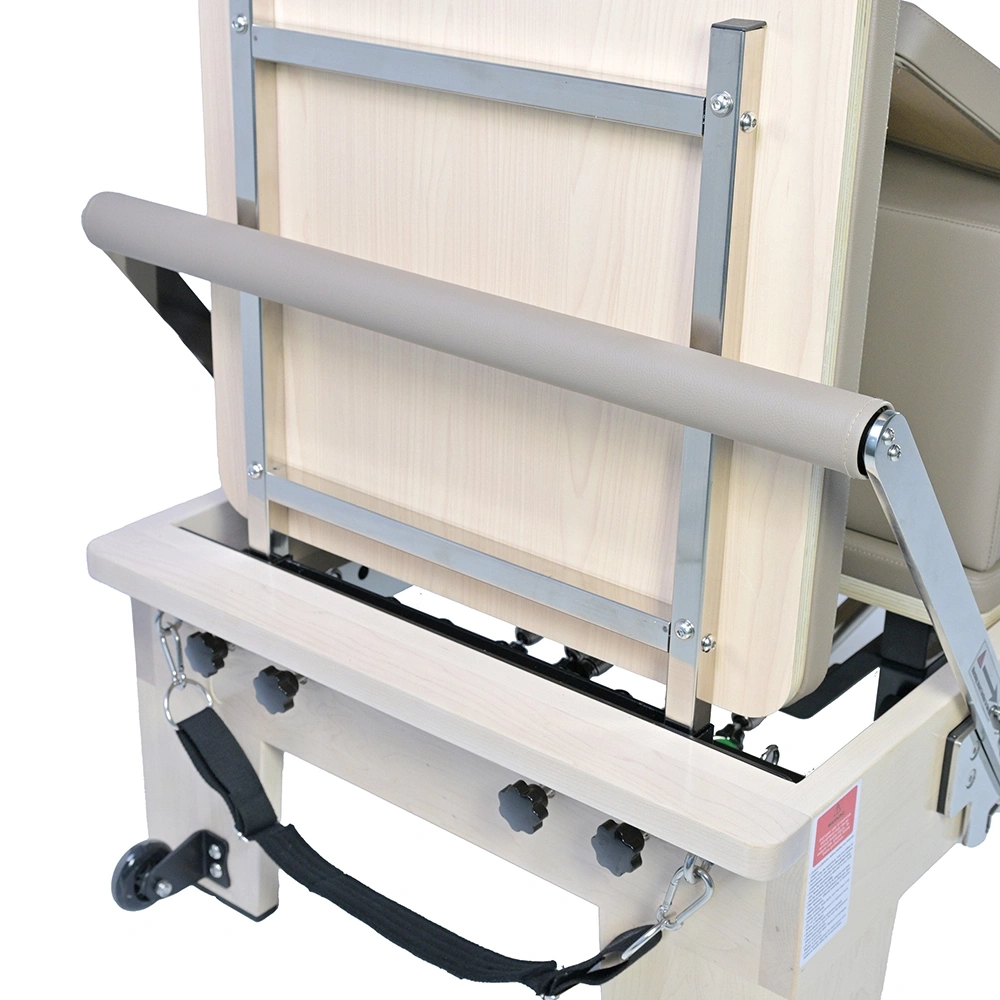
Metal or reinforced side supports help transform the board from a simple load-bearing panel into a more stable composite structure. This reduces flex and improves confidence during impact-heavy training.
Cross-Connection Structure
A crossbar or cross-connection design can help distribute forces more evenly between both sides. This improves torsional resistance and creates a more uniform rebound feel across the surface, especially useful during single-leg and tempo-based sequences.
Open Structure for Climate Adaptation
Wood reacts to temperature and humidity, especially in export markets, coastal regions, or spaces with inconsistent climate control. A design that avoids over-constraint can reduce long-term issues such as noise, cracking, and warping.
Modular Integration
Modular jump board integration helps isolate wear to the attachment system instead of transferring stress into the main reformer frame. This approach is widely valued in high-use machinery because it simplifies maintenance, improves serviceability, and protects the more expensive base unit.
For buyers sourcing wholesale reformer parts or complete commercial Pilates equipment packages, this kind of engineering can reduce long-term maintenance concerns and improve product lifespan.
Why This Matters for Studio Owners and B2B Buyers
Studio owners do not just buy equipment. They buy class quality, scheduling reliability, and member retention. A jump board that supports confident progression can influence all three.
When equipment feels stable, instructors tend to program more ambitiously. When classes feel better, students are more likely to return. And when components last longer, studios face fewer interruptions, fewer complaints, and lower after-sales friction.
That is why the conversation should not focus only on price. It should focus on training value over time.
For B2B buyers, distributors, and procurement teams, the most useful question is not whether a jump board works on day one. It is whether it still feels consistent after months of real studio traffic.
Conclusion
Jumpboard Pilates continues to grow because it offers something powerful: endurance, rhythm, athletic challenge, and Pilates-based control in one format. But the strongest jumpboard programs all rely on the same principle. Progression depends on trust.
When the board stays stable and consistent, students move with more confidence, instructors teach with more freedom, and studios build a repeatable class format that people want to come back to.
Upgrading a Pilates Reformer jump board is not just an equipment upgrade. It is a progression upgrade. In jumpboard Pilates, every landing either builds confidence or creates hesitation.
If your goal is to move beyond basic cardio-style jumping and develop a stronger long-term jumpboard system, improving board stability may be one of the smartest decisions you can make.
Looking to upgrade your studio equipment or source commercial-ready jump boards for export? Contact our team to discuss reinforced jump board solutions designed for high-traffic Pilates environments.
Frequently Asked Questions
u003cstrongu003eWhy do jump boards show problems earlier than other reformer parts?u003c/strongu003e
Because jumping creates high-frequency cyclic loading. Small weaknesses in stability, mounting integrity, or torsional resistance become noticeable faster through wobble, noise, and inconsistent rebound.
u003cstrongu003eWhat features matter most in a commercial Pilates jump board?u003c/strongu003e
For studio use, the most important features are structural stability, torsional resistance, durable attachment points, climate-tolerant construction, and service-friendly modular design.
u003cstrongu003eIs a home-use jump board good enough for a busy studio?u003c/strongu003e
Usually not for long-term, high-traffic performance. Home-use boards may work well under light demand, but commercial studios need equipment that can handle repeated impact from many users without losing consistency.
What is the difference between jumpboard Pilates and traditional Reformer Pilates?
Traditional Reformer Pilates usually emphasizes slow, controlled resistance, flexibility, and alignment. Jumpboard Pilates adds repeated landing and rebound cycles, which increase cardiovascular demand and develop endurance, coordination, and athletic movement.
Is jumpboard Pilates safe for people with bad knees?
It can be more joint-friendly than hard-surface jumping because the reformer springs absorb part of the impact. Safety still depends on stable equipment, proper spring settings, correct technique, and gradual progression with qualified instruction.
Read more engaging articles in the Gadgets category at Swifttech3.