Five letters.
Six chances.
One word the entire world tries to solve together.
That’s the entire premise behind what many now call the quintessential Wordle experience. And somehow, that tiny structure reshaped how millions of people begin their mornings.
In a digital era built on endless scrolling, autoplay videos, and algorithm-driven chaos, Wordle feels almost… disciplined. It starts. it challenges you. It ends.
And that’s exactly why it matters.
Let’s explore how this deceptively simple puzzle became the quintessential game of the modern web — and why it still holds attention years after its viral peak.
The Design Simplicity That Changed Everything

Wordle’s design is almost aggressively minimal:
- One puzzle per day
- Five-letter mystery word
- Six attempts
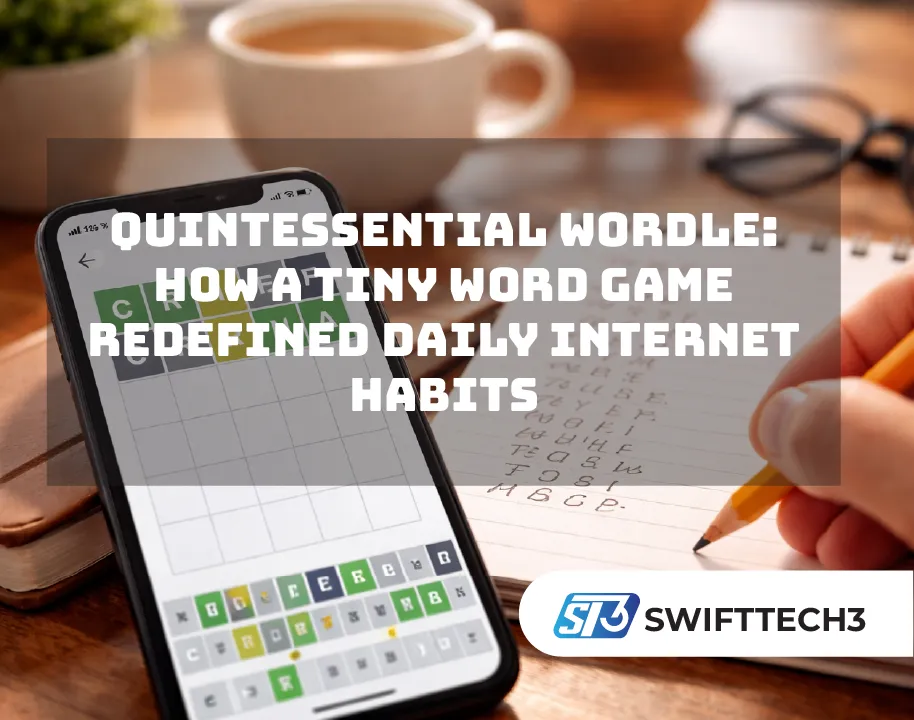
- Immediate feedback via colored tiles
There are no lives to buy. No ads flashing in the corner. No subscription walls blocking the core experience. You simply try to uncover the correct word using logic and deduction.
That minimalism is not accidental — it’s powerful.
Most online games compete by adding features. Wordle competed by removing them.
And that restraint is what makes the quintessential Wordle format so enduring.
The Ritual Effect: Why One Puzzle Per Day Works
If Wordle allowed unlimited play, it would lose its magic.
Scarcity creates value. One daily challenge transforms the puzzle into a ritual rather than a time-killer. It becomes part of routine — like checking the weather or reading headlines.
The daily constraint creates anticipation. You don’t binge Wordle. You wait for it.
That waiting is part of the psychological hook.
Shared Challenge in a Fragmented Internet
One overlooked reason Wordle exploded is synchronization.
Everyone gets the same word.
Not a personalized feed. Not a recommended puzzle. The same exact challenge across time zones and countries.
That shared constraint creates something rare online: collective focus.
When someone posts:
Wordle 941 – 3/6
You instantly know what they solved. You’ve faced it too.
That communal participation is central to the quintessential Wordle phenomenon. It turns solitary play into quiet social bonding.
Digital Minimalism: Wordle as an Antidote
Wordle’s success also reflects digital fatigue.
Modern apps demand constant engagement. Notifications compete for attention. Feeds are engineered to prevent stopping.
Wordle does the opposite.
It offers:
- A defined start
- A defined end
- No algorithmic manipulation
- No “recommended for you”
You either guess the correct word or you don’t. Then you move on.
There’s something calming about that closure.
The Beauty of Logical Constraint
Wordle works because it limits you.
Five letters force precision. Six attempts force discipline. The colored feedback forces strategic adjustment.
When you receive yellow and green tiles, your brain immediately starts to rearrange the letters mentally. You test patterns. You eliminate impossibilities.
You’re not guessing randomly — you’re reducing uncertainty step by step.
That sense of narrowing chaos into clarity feels deeply satisfying.
Why Failure Feels Different in Wordle
Losing in most games feels frustrating.
Losing in Wordle feels… instructive.
Because:
- The answer is revealed instantly
- You see exactly where you miscalculated
- Tomorrow brings a fresh start
There’s no punishment. No loss of rank. No penalty.
This low-stakes environment encourages repeat play without anxiety.
And that emotional safety is a big reason the quintessential Wordle structure still works.
Wordle in the Context of Modern Puzzle Culture
Before Wordle, daily puzzles were mostly associated with newspapers — especially crosswords.
Wordle modernized that concept:
- Browser-based
- Share-friendly
- Clean design
- Globally synchronized
It bridged traditional puzzle culture with internet-native behavior.
Instead of clipping newspaper puzzles, people share emoji grids. Same ritual, new medium.
The Subtle Strategy Layer
Even though Wordle feels simple, it quietly rewards analytical thinking.
Players gradually learn to:
- Prioritize high-frequency letters
- Recognize common five-letter word structures
- Avoid repeating eliminated letters
- Identify when to test new letters versus commit to structure
It becomes less about vocabulary depth and more about decision-making efficiency.
The quintessential Wordle player isn’t necessarily someone with the biggest dictionary — it’s someone who manages information wisely.
The Rise of Analytical Play
As the game matured, so did its community.
Players began tracking:
- Average guesses per puzzle
- Win streaks
- Hard Mode performance
- Statistical efficiency of starting words
The New York Times later introduced analytical tools like WordleBot, which evaluate performance and compare your strategy against optimized solutions.
That addition transformed Wordle from casual puzzle to data-driven challenge for some players.
But importantly, the core game remained unchanged.
The Emotional Micro-Rewards
Wordle delivers tiny emotional beats:
- First green tile = excitement
- Near-complete word = tension
- Final correct word = relief
These micro-rewards are powerful. They provide a structured emotional arc in under five minutes.
Very few digital products deliver a complete emotional cycle that efficiently.
Is Wordle Just a Trend?
Many viral games fade quickly.
Wordle didn’t.
Why?
Because it’s built on fundamentals:
- Language
- Logic
- Constraint
- Community
Those elements don’t expire.
Even when daily player numbers fluctuate, the concept remains durable. The quintessential Wordle formula is simple enough to survive platform changes and trend cycles.
The Hidden Lesson of Wordle
Beyond entertainment, Wordle teaches something subtle:
Progress through elimination.
Each guess reduces chaos. each clue refines direction. Each adjustment gets you closer to clarity.
In a strange way, it mirrors real problem-solving.
You don’t leap to certainty. You iterate.
And that’s why solving the correct word feels satisfying — not lucky.
Pros and Cons of the Quintessential Wordle Model
Pros
- Structured daily ritual
- Encourages logic-based thinking
- Accessible across devices
- No aggressive monetization
- Creates global shared experience
Cons
- Limited daily play
- Occasional frustration with uncommon words
- Can feel repetitive over long periods
Still, its strengths are structural, not superficial — which is why it endures.
Frequently Asked Questions
Why is Wordle described as “quintessential”?
Because it represents the purest form of modern digital puzzle design: simple, accessible, skill-based, and socially shareable.
Does Wordle require a large vocabulary?
Not necessarily. It rewards logical elimination more than obscure word knowledge.
Why only one puzzle per day?
The daily limit preserves anticipation and prevents burnout.
Is Hard Mode worth trying?
Yes. It increases discipline by requiring consistent use of revealed clues, making the experience more strategic.
Final Thoughts: Why Five Letters Still Matter
The quintessential Wordle experience isn’t about difficulty. It’s about design philosophy.
It proves that:
- Constraints can increase engagement
- Simplicity can outperform complexity
- Shared daily rituals still matter in digital spaces
Wordle doesn’t try to dominate your time. It earns a few focused minutes.
- You rearrange the letters.
- You chase the correct word.
- You either solve it or learn from it.
Then you close the tab.
And somehow, that small, contained challenge feels like enough.
For More Similar Articles Visits: Swifttech3