In the past few years, we’ve all seen a crazy wave of innovation with blockchain and AI. Everyone’s talking about ChatGPT, Bitcoin and Ethereum, crypto markets, and how artificial intelligence is changing every industry. But one of the biggest challenges right now is connecting these two worlds—AI and blockchain—in a way that’s not just hype, but actually useful in the real world.
That’s where Lightchain AI enters the frame, offering a new approach that blends AI power with decentralized ledger technology.
Unlike most trading platforms or coins that only focus on financial systems or digital assets, Lightchain AI is built with a mechanism designed to handle AI workloads directly. Instead of blockchain simply recording transactions or minting tokens, it aims to run model inference, optimization, and limited AI development inside its own Artificial Intelligence Virtual Machine (AIVM).
That’s not a small tweak—it’s closer to building a new kind of blockchain from scratch.
Why does this matter? Look at current trends in AI regulation and crypto adoption. People want more security and transparency in how AI models are used, while the blockchain community is hungry for real use cases beyond speculation. Lightchain AI positions itself right in the middle, saying: we can make AI decentralized, verifiable, and actually useful.
Proof of Intelligence: a new consensus idea
What really makes Lightchain AI stand out is its Proof of Intelligence (PoI) mechanism.
Instead of wasting energy like Proof-of-Work, or simply locking capital like Proof-of-Stake, the network rewards nodes for useful computation. Nodes perform AI-related tasks—such as inference, optimization, or data analysis—and earn rewards for completing them correctly.
This flips the traditional blockchain model. Imagine if the energy used for Bitcoin mining could instead train medical AI models, improve fraud detection systems, or analyze financial data. That’s the shift Lightchain AI is trying to make.
How PoI Fits Into Blockchain History
| Consensus Mechanism | Energy Use | Primary Output | Value to Society |
|---|---|---|---|
| Proof of Work (PoW) | Extremely High | Network security | Secure, but wasteful |
| Proof of Stake (PoS) | Low | Network security | Efficient, but centralized |
| Proof of Intelligence (PoI) | Moderate–High | AI computation | Trains models for real-world use |
The AIVM role
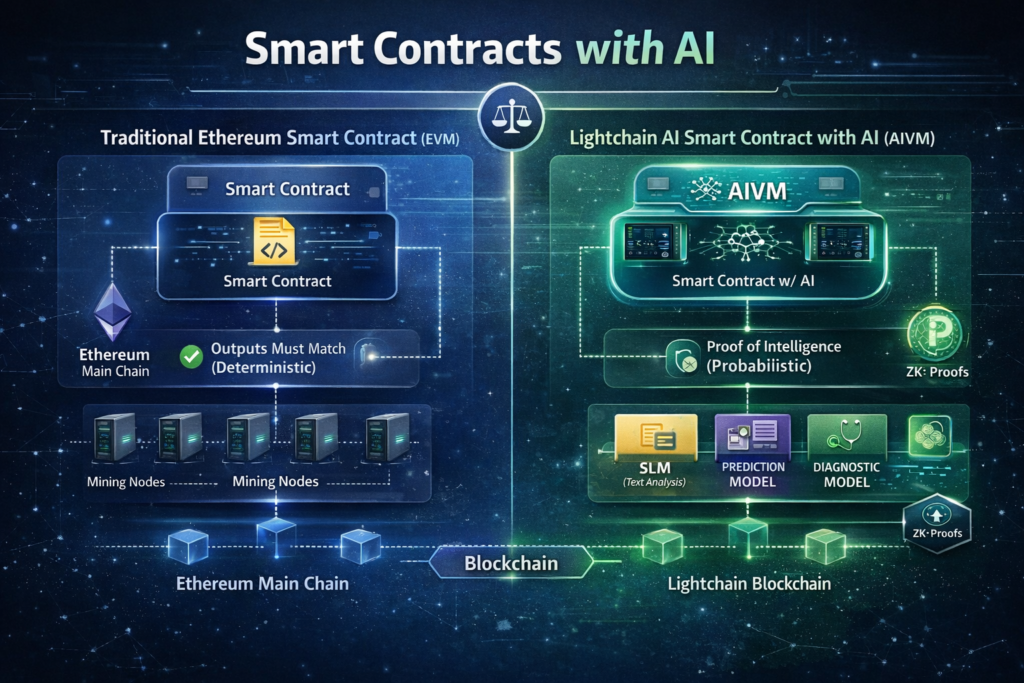
The Artificial Intelligence Virtual Machine (AIVM) is the backbone of Lightchain AI.
Traditional blockchains use virtual machines like Ethereum’s EVM to execute deterministic smart contracts. AI, however, is often probabilistic—meaning outputs can vary. The AIVM is designed to manage this challenge by isolating AI workloads in a specialized execution environment.
Rather than training massive models like GPT-4 on-chain (which isn’t realistic today), Lightchain focuses on:
- AI inference
- Small Language Models (SLMs)
- Optimization tasks
This keeps the system practical while still enabling AI-powered smart contracts.
- In finance, this could mean real-time fraud detection inside a contract.
- In trading platforms, AI models could react to market movements automatically.
- In healthcare, diagnostic models could run without relying on centralized data holders.
Funding & trust
Funding matters—and Lightchain AI has raised over $21 million in presale funding, placing it firmly in the “serious contender” category for Web3 projects.
Instead of rushing hype cycles, the roadmap focuses on:
- developer tooling
- real-world pilots
- gradual, transparent scaling
This approach helps reduce rug-pull concerns and builds longer-term trust. Coverage of decentralized AI by outlets like MIT Technology Review shows this isn’t an isolated idea—it’s part of a wider industry shift.
Possible use cases
Lightchain AI has potential across multiple industries:
- Finance & Crypto – AI-driven fraud detection inside smart contracts
- Trading Platforms – On-chain AI bots analyzing Bitcoin, Ethereum, and altcoins
- Healthcare – Decentralized diagnostics without centralized data control
- Smart Cities – AI for traffic, energy, and emergency response
- Education – Transparent, auditable grading models
These aren’t just theoretical. Many sectors already use AI—Lightchain adds trust and decentralization.
Challenges Lightchain AI still facing
Despite the promise, there are real hurdles.
Running AI on-chain is expensive, and scalability remains a challenge. Even with the AIVM, Lightchain must prove it can handle workloads efficiently.
Adoption is another issue. Developers are comfortable with Ethereum and Solana. Convincing them to migrate requires clear advantages, strong tooling, and incentives.
Network security and Proof of Intelligence
One big question is verification: How do you prove AI work was done correctly without redoing it?
In 2026, projects like Lightchain are experimenting with:
- Zero-Knowledge Proofs (ZK-SNARKs)
- Optimistic verification models
These allow the network to verify AI computation without re-running the entire model—one of the most important breakthroughs for decentralized AI.
Real world impact
The team behind Lightchain AI say they dont wanna just build tech toy. They aiming for real world pilot projects—banks, hospitals, even smart cities testing out financial technology and AI combos. For ex, in finance they imagine factor authentication embedded in every contract, making it harder for fraud to sneak in.
In trading world, AI bots could track market movements of bitcoin, ethereum and altcoins directly on-chain. No broker, no centralized control, just real time AI running on Lightchain nodes. That kinda independence is exactly what crypto enthusiasts always wanted.
Community and tokenomics
Lightchain AI’s total supply is capped at 21 million tokens, mirroring Bitcoin’s scarcity model. Rewards go to nodes that contribute meaningful compute, creating a direct link between network growth and real output.
Community sentiment is mixed—some see it as the next evolution of Ethereum, others remain cautious. Either way, it stands out from low-effort meme coins by offering actual infrastructure.
Pros & cons quick view
Pros
- Real AI workloads on-chain
- Proof of Intelligence replaces wasteful mining
- Strong use cases in finance, healthcare, and trading
- Predictable token supply
Cons
- High technical complexity
- Competing with mature ecosystems
- Verification and scaling still evolving
Tips for users
- If you’re investor: keep eye on roadmap and real-world pilots, not just hype.
- For devs: explore the smart contract tools inside AIVM and test small models before full apps.
- For regulators: Lightchain AI may become test ground for merging AI and blockchain policy.
- For community: focus on governance—avoid whales dominating compute.

FAQ’s
How is Lightchain AI different from Bittensor (TAO)?
Lightchain AI focuses on AI models living inside smart contracts via the AIVM, while Bittensor operates more as a decentralized AI marketplace.
Can I earn Lightchain tokens with my home computer?
Most reward nodes require high-performance GPUs, making it more suitable for professional setups.
What is a “Smart Contract with AI”?
It’s a contract that can make decisions based on AI analysis—for example, releasing insurance payouts after AI verifies satellite images.
Wrapping it up
Is Lightchain AI the future of decentralized intelligence? Maybe. What’s clear is that it’s pushing the conversation forward—showing how blockchain can evolve beyond money and NFTs.
If Lightchain solves compute efficiency and verification at scale, it could mark the start of a new era where AI isn’t controlled by a few corporations, but powered by a global network.
Even if it doesn’t fully succeed, ideas like Proof of Intelligence and AIVM will influence the next generation of decentralized systems. And that’s what keeps this space exciting.
Read more engaging articles in the Artificial Intelligence category at Swifttech3.