Daily, manufacturing operations consist of many different interrelated processes that can each be operating concurrently. Any time a single procurement item might be delayed, it will delay the entire production schedule and the delivery timelines and customer commitments for many other orders.
Inventory accuracy is just as disruptful as seriously. If the count of raw material inventory is incorrect, a production line can unexpectedly stop, employees will be sitting idle, and the facility will incur considerable recovery expenses.
This is why so many manufacturers are looking to implement an Odoo ERP Implementation solution for their production planning, inventory management, procurement, quality control, and real-time reporting functions as one connected operational platform
2. Why is it increasingly difficult to manage manufacturing operations as companies grow?
The increase in complexity of manufacturing operations has outpaced the increases in employee count. As a result, it is virtually impossible to manually oversee manufacturing operations and maintain visibility into the entire operation while keeping some semblance of control over them.
1. Increasing Product Catalog Size
The growth of the product catalog is increasing the number of bill of material (BOM) configurations, raw material combinations and production routes that need to be tracked throughout the facility.
2. Increase in number of Suppliers
With the increase in number of suppliers, there is a greater need for tracking lead times, pricing agreements, delivery schedules and performance metrics. All of these need to be tracked with some level of reliability, and typical spreadsheets do not have the capability to address these requirements.
3. Increase in Number of Inventory Locations
As warehouse square footage expands, so do the visibility gaps associated with inventory. In order to effectively track inventory across multiple locations, it is necessary to have a central inventory management system.
4. Increase in Number of Production Orders
The number of production orders has increased significantly due to the overall increase in customer demand and thus has increased the complexity of scheduling. Work centers will inevitably become bottlenecks if there is not a cohesive ERP and manufacturing resource planning (MRP) system in place to ensure that delivery commitments can be met.
5. Increase in Number of Varied Customer Demand
There are currently trends of market variability, seasonal demand fluctuations, and last-minute changes to orders or customer requirements which require that manufacturing plants be able to access real time data in order to modify production schedules without disrupting production workflow.
Manufacturing companies must begin to use an integrated manufacturing ERP system in order to effectively speed up the ability to manage through the complexity created by the aforementioned trends.
3. How Odoo ERP Connects the Entire Manufacturing Workflow?
Using Odoo’s ERP connects and fills the gap of information between departments via a single source of truth for the entire manufacturing process.
- Customer Orders
Through Odoo’s Sales module, the sales team creates and captures all customer orders that have been confirmed along with the demand and all teams involved in production, inventory and procurement can view that demand without the need for any manual data entry.
- Sales Planning
Odoo’s capacity to link confirmed sales orders with the company’s expected demand provides manufacturers with the ability to have their production capacity in line with expected customer demand rather than past data.
- Materials Requirements
The Odoo MRP module calculates the material needed to produce any products with confirmed production orders, based upon what the company has in stock and to flagting any stock out of line with production scheduling.
- Purchase Orders
Odoo generates purchase orders automatically when there is a material shortage by reviewing supplier lead time and reorder point thus always having procurement tie in with placement of goods within the production schedule.
- Production Orders
Odoo creates fully structured purchases from material needs and sales demand with the automatic assignment of resources, scheduling of work centers, and provision of work instructions for all shop floor employees.
- Quality Control Checks
Using Odoo’s Quality Control Module directly ties production workflow with the inspection of all raw materials, production components, and finished goods to ensure that they all meet the same standards before moving forward.
- Dispatch from the Warehouse
After the manufacturing of the product is finished and passes the quality control checks, Odoo manages all aspects of warehouse dispatching; including updating stock records, creating delivery orders and providing notification to the logistics department as soon as an order is completed.
By removing most of the manual coordination that slows down many manufacturers due to intensive communication efforts to create a “connected” end-to-end operational system that uses accurate, real-time data.
4. How Odoo ERP Improves Critical Manufacturing Operations?
From Planning to Delivery
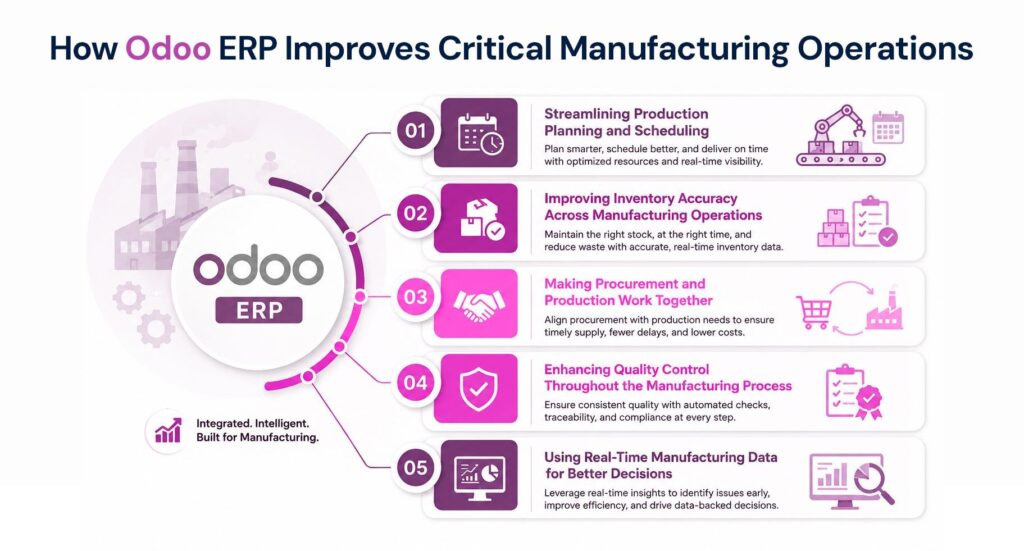
There are measurable results from an Odoo ERP implementation in the core functional areas of manufacturing that businesses use to run their daily operations. The different sections of this document will describe how Odoo will transform these key areas: production planning; inventory accuracy; procurement; quality; and real-time decision-making.
4.1 Streamlining Production Planning and Scheduling
Using Odoo ERP, manufacturers can change from an “Emergency” method of managing production; to create a working, detailed plan based on real-time data that improves the flow of work and eliminates expensive delays between operations.
- Real-time Planning for Production
Production orders are created automatically by Odoo, based on confirmed sales and materials in stock. Planners know immediately what they need to produce. Less manual coordination is needed before production can start.
- Capacity Visibility
Using the work centre scheduling feature in Odoo, machine capacity is visible in real-time. Manufacturers will be able to identify any bottleneck before it happens and will be able to distribute workloads to other work centres to keep output at the same level.
- Smarter Production Scheduling
Odoo will optimize production schedules by considering materials available, work centre capacity, and delivery date all at the same time, which means that will minimize idle time, provide less downtime to produce goods, and improve the efficiency of all resources throughout the facility.
Manufacturers using Odoo for production planning frequently report shorter production lead-times, better coordination on the shop floor, and fewer last minute changes to their schedules which disrupt the operation.
4.2 Improving Accuracy of Inventory in Manufacturing
Inaccurate inventory can be one of the most common and expensive challenges manufacturers face. Odoo’s inventory management solution provides manufacturers with real-time visibility and control over all of their internal stock movements within a facility.
- Real-time tracking of inventory
Odoo allows manufacturers to real-time track their raw materials, components, and finished products in every warehouse location. All stock movement is recorded in real-time, so teams can rely on the accuracy of their inventory counts without needing to manually count or reconcile their inventory with any paperwork.
- Automated restock orders
With Odoo’s automatic restock orders, when manufacturers reach a specific re-order point (threshold) for an item, Odoo automatically generates purchase orders to replenish that item. This prevents manufacturers from running out of the raw materials that support their production lines and eliminates the reactive stock ordering process that increases costs for purchasers; thereby, improving the preventive stock ordering process.
- Centralized visibility to inventory in all warehouses
Manufacturers with multiple warehouses have centralized inventory visibility with Odoo. From a central dashboard, manufacturers can view all stock levels, stock-to-stock transfers, and availability across all warehouses, with no need to switch between systems.
By utilizing Odoo for inventory management, manufacturers will realize reductions in inventory-related production interruptions, reductions in warehousing carrying costs and an overall improvement in business operations and the reliability of the manufacturing process.
4. 3 Improving synergy between procurement and production
In manufacturing, procurement plays an important role in the success of production. By using Odoo to connect procurement to production, manufacturing companies can rely upon having materials available for use in production, ensuring that they do not experience delays or cancellations of production orders related to material availability.
- Automated material planning
Odoo links material requirements directly with confirmed production orders; when a production order is created, Odoo automatically calculates what materials are needed and checks what stock is currently available.
- Faster supplier coordination
Odoo automatically generates purchase orders based upon actual production demand (based upon confirmed production orders) and supplier lead time. This results in less manual coordination between procurement staff and suppliers and more time spent making strategic spend decisions.
- Reduced material delays
With Odoo, purchase orders are created at the right time based upon production schedules, which ensures that material arrives at the same time that it is actually needed for production. Hence, there are fewer early deliveries, which take-up valuable storage space, and fewer late deliveries that cause disruption to production activities.
When procurement and production teams use the same data within Odoo, manufacturing companies achieve a more orderly and predictable execution process of production activities, fewer emergency purchases and more reliable procurement-related impacts on production.
4.4 Enhancing Quality Control Throughout the Manufacturing Process
Odoo embeds quality control directly into manufacturing workflows, ensuring product standards are maintained at every production stage rather than being checked only at the end of the line.
1. Quality Control Before Every Manufacturing Step
Odoo enables manufacturers to define points of quality control at the time they receive raw materials, when they will be transmitting raw materials into a completed product, and at the time they finish a manufactured product. This allows for defects to be detected far earlier in the production process, which will save manufacturers considerable amounts of time and money by reducing the rate of defects, and reducing the amount of items they have to put in the trash.
2. Product Traceability
Odoo provides manufacturers with the ability to track the entire manufacturing process from the raw materials they began with through to when they finish an item. This supports internal quality control and also supports external compliance with applicable laws and regulations.
3. Support for Compliance with Applicable Laws and Regulations
The Odoo Quality Module provides manufacturers with the tools they need to consistently produce quality manufactured products and maintain appropriate documentation of their quality control inspection results to demonstrate compliance with applicable laws and regulations. This results in having appropriate records readily available for audit purposes and will allow manufacturers to show that they are complying with applicable laws and regulations.
By embedding quality control into a manufacturer’s daily operations using Odoo, manufacturers will reduce defect rates, improve the consistency of the manufactured product being produced, and protect customer relationships by providing customers with the quality manufactured products that they are expecting to receive.
4.5 Using Real-Time Manufacturing Data for Better Decisions
Odoo allows manufacturing managers to make informed decisions quickly because of the real-time operational data provided by Odoo, which is replacing the outdated, slow performance of historical reportings and the inconsistencies of missing data historically associated with the production environments.
1.Live Monitoring of Production Orders
Odoo allows management to monitor their live status for production orders, monitor work centres, and view the production progress of an order without ever having to physically walk the floor of the plant to check on any orders. Managers can see what point of the production process each order is at, to make better and faster decisions.
2.Operational Dashboards
Odoo has dashboards that allow management to view and monitor data such as production performance, inventory levels, procurement status and quality measurements in one consolidated view. Therefore, all levels of management have real-time access to a complete operational view of the businesses and do not have to wait for consolidated production reports from multiple systems.
3.Cost and Efficiency Monitoring
Odoo provides management with real-time data on material usage, labour usage, production costs and efficiency of brakes in their operation, enabling managers to see when their actual costs exceed their plan and take corrective action before the overage becomes excessive.
Having access to near real-time manufacturing data for decision-making using Odoo allows manufacturing managers to make better, faster decisions that will reduce waste, improve output, and align the performance of production with the overall objectives of the business.
5 The Operational Results Manufacturers Experience with Odoo ERP
Odoo ERP in their businesses have had tangible benefits across all areas of their manufacturing operations. Surveys of manufacturers using Odoo ERP have documented measurable improvements to their production cycle times, inventory controls, procurement processes, and team collaboration which continue to grow over time as the manufacturers utilize the full functionality of Odoo ERP.
1) Increased Speed to Produce Orders
Due to improved automation of the planning process, material verification process, and generation of work orders, Odoo ERP enables manufacturers to shorten the lead time between order receipt confirmation and actual production activity. In essence, manufacturers produce orders in less time, but do so without increasing their operation headcount.
2) Increased Control Over Inventory
With real-time tracking of products, and automatic replenishment via Odoo ERP, manufacturers are not subject to either stockouts or excessive inventories. This permits manufacturers to hold only the minimum level of inventory necessary to support production.
3) Less Manual Labor
Manufacturers have reduced sand automate repetitive task(s) associated with procurement, production scheduling, inventory updates, and reporting. As a result, team members can devote less time entering data about tasks they have completed and spend more time making decisions that positively impact their manufacturing operation.
4) Enhanced Collaboration Between Departments
Sales, production, procurement, and warehouse departments all work in the same Odoo ERP environment. Because information flows automatically from sales to production to procurement and finally to the warehouse, coordination between departments is improved, the number of miscommunicated events is reduced, and response times to operational requests are improved.
5) Increased Incidence of Deliveries Made On-Time
With improved production planning and improved accuracy of inventory levels because of Odoo ERP, manufacturers can provide their customers with higher levels of service by delivering more of their products on time. This ultimately has a positive impact on customer relationships and the cost of managing customer complaints for late deliveries.
6)Improved Operational Visibility
Using Odoo allows leadership to have a real-time perspective on the entire factory’s level of performance at an operational level. This allows managers to identify problems at a much earlier point in time and allocate available resources in a more efficient manner. By using real-time, accurate data, managers can make timely decisions relative to their operational management needs.
7)Scalable Operations Without Additional Complexity
The Odoo product platform can scale with your manufacturing operations as they grow. As you expand your business with new product lines, suppliers or warehouses, you do not have to invest in new software to manage these added layers of complexity; instead, you can continue to use the same software for both your existing and new operations without increasing operational cost.
These benefits are not the result of the software alone, but rather the end result of connecting all people, processes, and data across a single manufacturing ERP platform; that is, every manufacturing team has all of the necessary tools to do their jobs successfully.
Conclusion
Manufacturing companies are able to transition from a fragmented, manual way of doing things into an inter-linked system for production planning, inventory tracking, procurement, and quality control using only the same real-time data by installing the Odoo ERP.
The manufacturers see ongoing operational improvement from their relationship with Odoo, not just once when they initially experience the benefits of the software. As users become more familiar with Odoo, their ability to create and execute process improvements increases, speedier decision-making occurs, and their overall manufacturing operations become increasingly robust and scalable very slowly over time and with the combination of these things together.
Visit: Swifttech3