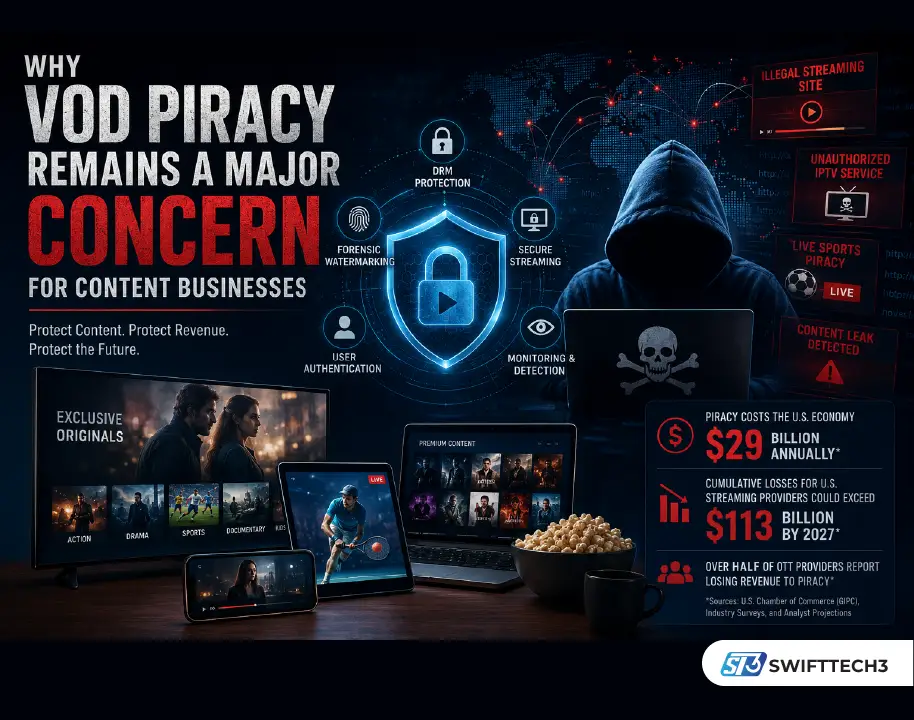
The global streaming industry has transformed how audiences consume entertainment, education, sports, and digital media. However, alongside this growth, VOD piracy continues to create significant challenges for content owners, distributors, and streaming platforms. As video-on-demand services expand their libraries and invest heavily in original content, unauthorized distribution remains one of the biggest threats to revenue protection and long-term business sustainability.
For content businesses, piracy is no longer simply a copyright issue. It has evolved into a complex technological, financial, and operational challenge that requires continuous monitoring and protection strategies. Industry surveys reinforce this: more than half of OTT providers report having lost revenue to piracy before implementing stronger protections, and analysts project that piracy will cost U.S. video providers over $113 billion in cumulative lost revenue by 2027.
Understanding the Scale of the Problem
The popularity of streaming services has created unprecedented demand for digital content. Consumers expect instant access to movies, television shows, live events, training programs, and premium video libraries across multiple devices. Unfortunately, the same technologies that make content delivery convenient also make unauthorized copying and redistribution easier.
Pirated content can appear through:
- Illegal streaming websites
- Unauthorized IPTV services
- Screen recording tools
- Credential sharing networks
- Content ripping software
- File-sharing platforms
The rapid distribution of digital content means that even a single security breach can affect thousands of users in a short time. Piracy has also changed shape in recent years. The torrent-driven download model that defined the 2000s has increasingly given way to instant, access-based piracy — unauthorized streaming sites, IPTV-style apps, and browser-based portals that mimic the look and feel of legitimate platforms. For many casual users, this shift makes pirated content feel indistinguishable from a paid subscription, which is part of why detection and takedown efforts have become more difficult.
The Financial Impact on Content Businesses
Producing premium video content requires substantial investment.
Businesses often allocate significant resources toward:
- Content creation
- Licensing agreements
- Production teams
- Post-production processes
- Marketing campaigns
- Platform infrastructure
When pirated copies become available, legitimate subscription revenue can be affected. Consumers who access unauthorized content may bypass official channels entirely, reducing potential earnings from subscriptions, rentals, advertising, and pay-per-view services.
The scale of this impact is difficult to pin down precisely — estimates vary depending on methodology — but multiple industry studies point in the same direction. The U.S. Chamber of Commerce’s Global Innovation Policy Center has estimated that digital video piracy costs the U.S. economy roughly $29 billion a year in lost revenue, while separate analyst projections put the cumulative loss for U.S. streaming providers at over $113 billion by 2027. These figures should be read as directional estimates rather than precise accounting, since researchers differ on how much pirated consumption would have converted to paid subscriptions in the first place. Even accounting for that uncertainty, the consistent finding across studies is that piracy measurably suppresses legitimate revenue, particularly in markets with high subscription costs or fragmented content libraries.
For smaller content creators and independent platforms, these losses can have an even greater impact on future content development and business growth, since they typically operate with thinner margins and less capacity to absorb lost income than major studios or global platforms.
Piracy Undermines Content Value
Exclusive content is often a major competitive advantage.
Streaming platforms differentiate themselves through:
1. Original Programming Exclusive shows and films help attract new subscribers.
2. Premium Events Sports broadcasts, concerts, and special events often generate significant audience interest. Live sports piracy in particular has grown quickly, since the value of a live stream is highest in the moment and pirated feeds can undercut official broadcasts in real time, before takedown requests are even processed.
3. Specialized Content Libraries Educational, corporate, and niche content platforms rely on unique content collections to maintain subscriber loyalty.
When unauthorized copies circulate freely, the exclusivity that helps drive subscriptions becomes less effective. This can reduce the perceived value of premium offerings over time, and it can also complicate licensing negotiations, since rights holders may be less willing to grant exclusive windows to a platform that cannot demonstrate strong piracy controls.
The Growing Sophistication of Piracy Networks
Modern piracy operations have become increasingly organized.
Many illegal distributors now operate sophisticated systems capable of:
- Capturing content automatically
- Redistributing streams in real time
- Avoiding detection
- Creating mirror websites
- Monetizing traffic through advertising
These operations often function across multiple jurisdictions, making enforcement more challenging. As anti-piracy technologies improve, piracy networks continuously adapt their methods to bypass security controls. Some pirate services now generate substantial revenue of their own — reports have documented individual illegal streaming operations pulling in millions of dollars a month through advertising and subscriptions before being shut down by law enforcement, illustrating how commercialized this ecosystem has become.
Brand Reputation Risks
Piracy affects more than revenue. It can also influence brand perception.
When consumers access unauthorized copies, they may experience:
- Poor video quality
- Incomplete content
- Malware exposure
- Broken streams
- Fake websites impersonating legitimate services
Although the official content owner is not responsible for these issues, users may still associate negative experiences with the original brand. Protecting content, therefore, becomes part of protecting customer trust. This is especially true for services that license out well-known franchises or celebrity talent, where a poor-quality pirated stream circulating under the brand’s name can create lasting confusion in the market.
Why Security Must Be Built Into Distribution
Many businesses focus heavily on content creation while underestimating the importance of distribution security.
Effective protection often involves multiple layers, including:
1. Digital Rights Management (DRM) DRM systems help control how content is accessed and viewed. Most premium streaming services rely on a combination of DRM standards, since no single system covers every device: Google’s Widevine for Android and Chrome, Apple’s FairPlay for iOS and macOS devices, and Microsoft’s PlayReady for Windows and connected TV platforms. Because each platform requires its own implementation, many businesses use a multi-DRM approach — often delivered as a managed service — to apply consistent protection across devices without maintaining separate systems for each one.
2. Secure Streaming Protocols Encrypted delivery methods reduce unauthorized interception.
3. User Authentication Account verification helps prevent misuse, including limiting the number of concurrent streams per account to curb credential sharing.
4. Watermarking Technology Invisible identifiers embedded in the video — often called forensic or session-based watermarking — can help trace unauthorized content back to the specific account, device, or distribution point where a leak originated, without being visible to the viewer.
Businesses increasingly recognize that security should be integrated throughout the content lifecycle — from production and post-production through delivery and playback — rather than added after distribution begins. It’s also worth being realistic about limits: no single layer of protection is unbeatable on its own, and determined pirates continue to find workarounds for individual controls. This is why most content security strategies combine DRM, encryption, watermarking, and monitoring rather than relying on any one method in isolation.
The Challenge of Global Accessibility
Streaming platforms frequently serve audiences across multiple countries and regions.
While global accessibility supports growth, it also increases exposure to piracy risks.
Different markets may have:
- Varying copyright regulations
- Different enforcement capabilities
- Diverse technology infrastructures
- Unique consumer behaviors
Managing content protection across international markets requires a comprehensive and adaptable strategy. Enforcement mechanisms also differ significantly by region — some markets rely on dynamic site-blocking injunctions that can add newly discovered piracy domains to a blocklist without a fresh court order each time, while others still require case-by-case legal action, which slows takedown response times considerably. This complexity explains why many organizations invest heavily in monitoring and anti-piracy solutions rather than relying solely on legal enforcement.
Consumer Expectations Continue to Evolve
Audience expectations have changed significantly.
Modern viewers expect:
- Instant access
- High-quality streaming
- Multi-device compatibility
- Personalized experiences
- Reliable performance
When legitimate services fail to meet these expectations, some users may seek unauthorized alternatives. Rising subscription costs and content fragmentation across multiple platforms are frequently cited as factors that push otherwise willing customers toward pirated sources — surveys have found that a majority of younger viewers admit to using unauthorized platforms even while maintaining paid subscriptions elsewhere. For this reason, combating piracy is not solely about enforcement. It also involves improving user experience, reducing friction, and making legitimate access convenient, fairly priced, and attractive.
The Role of Monitoring and Detection
Many content businesses now adopt proactive monitoring approaches.
Continuous surveillance helps identify:
- Illegal streams
- Unauthorized uploads
- Content leaks
- Credential abuse
- Distribution networks
Early detection allows businesses to respond more quickly before widespread distribution occurs. This proactive approach has become increasingly important as piracy methods continue evolving. At the same time, organizations are using artificial intelligence and automated analytics to identify suspicious activity faster and more accurately — for example, by crawling social media platforms, messaging apps, and known piracy sites to flag leaked content and trigger takedown workflows automatically. In practice, monitoring tends to work best when it’s paired with a clear escalation process: automated detection identifies a likely leak, a human review step confirms it, and a takedown or legal notice follows quickly, since delays of even a few hours can allow a pirated live stream to reach a large audience.
Why Piracy Concerns Will Continue
The streaming market is expected to continue growing across entertainment, education, sports, corporate training, and media sectors.
As content value increases, piracy incentives are also likely to increase.
Future challenges may involve:
- AI-assisted piracy methods
- More advanced stream capture technologies
- Cross-platform distribution networks
- Sophisticated content replication tools
Businesses that view content protection as a long-term strategic priority — rather than a one-time technical fix — will be better positioned to manage these risks effectively.
Frequently Asked Questions
What is VOD piracy?
VOD piracy refers to the unauthorized access, copying, or redistribution of video-on-demand content — including movies, TV shows, sports broadcasts, and educational or corporate video — without permission from the rights holder. This can happen through illegal streaming sites, unauthorized IPTV services, screen recording, or credential sharing.
How much revenue does piracy cost streaming businesses?
Estimates vary by study and methodology, but industry research consistently shows significant losses. U.S. government-linked estimates put annual losses from digital video piracy at around $29 billion, while other analyst projections estimate cumulative losses for U.S. streaming providers could exceed $113 billion by 2027. These are estimates rather than precise figures, since not every pirated view represents a lost paid subscription.
What is DRM and how does it prevent piracy?
Digital Rights Management (DRM) is a set of technologies that encrypts video content and controls how, where, and by whom it can be played. Common DRM systems include Widevine, PlayReady, and FairPlay. DRM doesn’t make piracy impossible, but it significantly raises the technical difficulty and cost of unauthorized copying, which deters casual piracy and slows down more determined actors.
What is forensic watermarking?
Forensic watermarking embeds a unique, invisible identifier into video content — often tied to a specific user session, account, or distribution point. If that content is later found on a pirate site, the watermark can help trace where the leak originated, which supports both takedown efforts and legal action.
Can piracy ever be completely eliminated?
No content protection strategy can eliminate piracy entirely. The realistic goal is risk reduction: making unauthorized access difficult and costly enough that it discourages most piracy, while enabling fast detection and takedown for the piracy that does occur. Businesses that describe their approach as “piracy-proof” should be viewed with some skepticism, since determined and well-resourced piracy operations continue to adapt to new protections.
Why do people use pirated streaming services even when they have paid subscriptions?
Research suggests that rising subscription costs, content fragmentation across too many platforms, and the inconvenience of managing multiple accounts are common drivers. Some viewers use pirated sources for content unavailable in their region or on their existing subscriptions, rather than as a full replacement for paid services.
Is credential sharing considered piracy?
Credential or password sharing sits in a gray area. Sharing within a household is typically permitted under most platforms’ terms of service, but organized reselling of shared logins — sometimes through third-party marketplaces — is generally treated as unauthorized access and a form of piracy, since it allows unlimited unpaid viewers to access paid content.
How do streaming platforms detect pirated content?
Most platforms combine automated web crawling and AI-based pattern recognition with human review. Automated tools scan piracy websites, IPTV apps, social media, and messaging platforms for unauthorized copies, flag likely matches, and trigger a takedown or legal notice, often supported by forensic watermarking to confirm the source of a leak.
Does live sports piracy differ from on-demand content piracy?
Yes. Live sports piracy is especially damaging because the value of the broadcast is concentrated in a narrow live window. A pirated stream that reaches viewers during the event itself can cause real-time revenue loss that a takedown notice issued afterward cannot recover, which is why sports rights holders often invest in real-time monitoring and rapid app/site removal rather than after-the-fact enforcement alone.
A Practical Perspective
Content teams that have gone through a piracy incident tend to describe a similar pattern: the first unauthorized copy rarely causes major damage on its own, but the speed of the response determines how far it spreads. A leak that’s detected and taken down within hours typically stays contained to a handful of piracy sites; the same leak left unaddressed for a few days can be mirrored across dozens of platforms and become effectively impossible to fully remove. This is one of the clearest practical lessons in content protection — prevention (DRM, encryption, access controls) reduces how often leaks happen, but monitoring and response speed determine how much damage each leak actually causes.
Conclusion
As digital streaming continues to expand, VOD piracy remains one of the most significant challenges facing content businesses. Revenue protection, brand reputation, content exclusivity, customer trust, and long-term growth are all affected by how effectively organizations safeguard their digital assets. Addressing piracy requires a combination of technology, monitoring, security planning, and ongoing adaptation to emerging threats — no single tool or policy solves the problem on its own.
For businesses evaluating their own exposure, a reasonable starting point is an honest audit: which content is unprotected or under-protected, how quickly would a leak be detected today, and how fast could it realistically be taken down. As piracy techniques continue to evolve — including the use of AI-assisted tools by pirate operations — the businesses best positioned to protect their revenue will be the ones that treat content security as an ongoing operational discipline rather than a one-time setup.
If you are looking for professional content security and streaming protection solutions, DoveRunner operates within the digital content delivery and protection ecosystem. The company focuses on helping organizations manage video distribution, content security, streaming infrastructure, and audience delivery challenges — including multi-DRM licensing (Widevine, PlayReady, and FairPlay), forensic watermarking, and anti-piracy monitoring — while supporting secure and efficient digital media experiences in an increasingly connected online environment.
Visit: Swifttech3