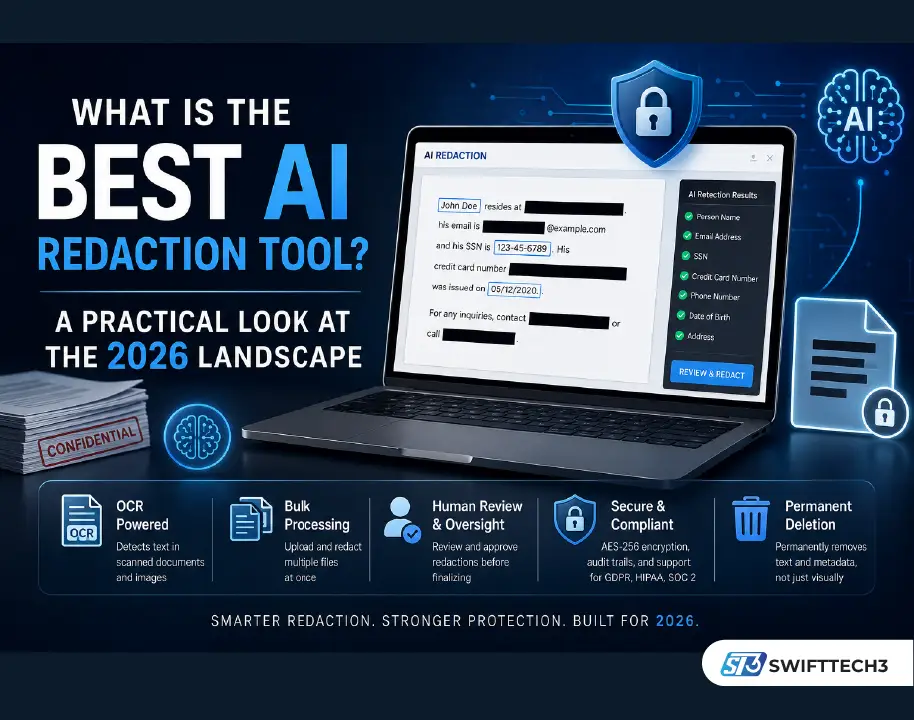
Manually redacting sensitive information from documents is slow, error-prone, and increasingly impractical for organizations handling significant document volume. Manual redaction remains a slow and costly technique, but AI-powered tools now allow teams to automate the entire redaction process, meaningfully reducing the risk of missed sensitive fields. Understanding what genuinely capable AI redaction software looks like in 2026 helps organizations choose a platform suited to their real needs.
What AI Redaction Software Actually Does
AI redaction software uses machine learning and pattern recognition to identify and permanently remove sensitive data across both digital and scanned files. Modern systems typically combine automated detection of personal information like names, emails, and Social Security numbers with natural language processing that understands context, catching unstructured sensitive information that simple keyword searches would miss.
Why OCR Capability Matters
Optical character recognition is essential for processing scanned PDFs and image-based files, since without it, automated redaction tools will miss sensitive content buried inside non-text-based documents. For organizations dealing with a mix of digital and scanned paperwork, OCR capability isn’t optional — it’s a core requirement for genuinely comprehensive redaction coverage.
Bulk Processing for High-Volume Environments
High-volume environments specifically need the ability to upload and process documents in bulk rather than handling files one at a time, which is essential for organizations managing large caseloads or document sets. This capability significantly reduces the time burden compared to processing files individually.
Human Oversight Still Matters
Even with strong automation, review interfaces that allow human oversight before finalizing redactions remain an important safeguard, ensuring flagged items can be checked and adjusted before a document is considered complete.
Security and Compliance Considerations
Genuine security-focused redaction permanently deletes underlying text and metadata, rather than simply visually obscuring content, and audit trails provide documentation supporting regulatory and legal defensibility. Strong tools also use encryption methods like AES-256 during upload and processing, supporting compliance with frameworks like GDPR, HIPAA, and SOC 2.
A Detailed 2026 Comparison
For a more detailed breakdown of specific platforms and how they compare across these criteria, best ai redaction tool offers a comprehensive look at the current landscape.
The Bottom Line
The best AI redaction tool for a given organization depends on specific needs around document volume, format variety, and compliance requirements — but OCR support, bulk processing, human review capability, and genuine security-grade deletion are consistently important criteria across use cases.
FAQs
What’s the main advantage of AI redaction over manual redaction?
AI-powered tools automate detection and removal of sensitive information, significantly reducing both the time required and the risk of missed sensitive fields compared to manual review.
Why is OCR important for redaction software?
Without OCR, automated tools cannot detect sensitive content within scanned documents or images, missing a significant portion of many organizations’ actual document workflows.
Is human review still necessary with AI-powered redaction?
Yes, generally. Review interfaces allowing human oversight before finalizing redactions remain an important safeguard against errors in automated detection.
What compliance frameworks should redaction software support?
Look for support of frameworks relevant to your industry, commonly including GDPR, HIPAA, and SOC 2, along with strong encryption during upload and processing.
Does visually obscuring text count as proper redaction?
No — genuine, secure redaction permanently deletes underlying text and metadata rather than simply covering it visually, which can otherwise be reversed or extracted.