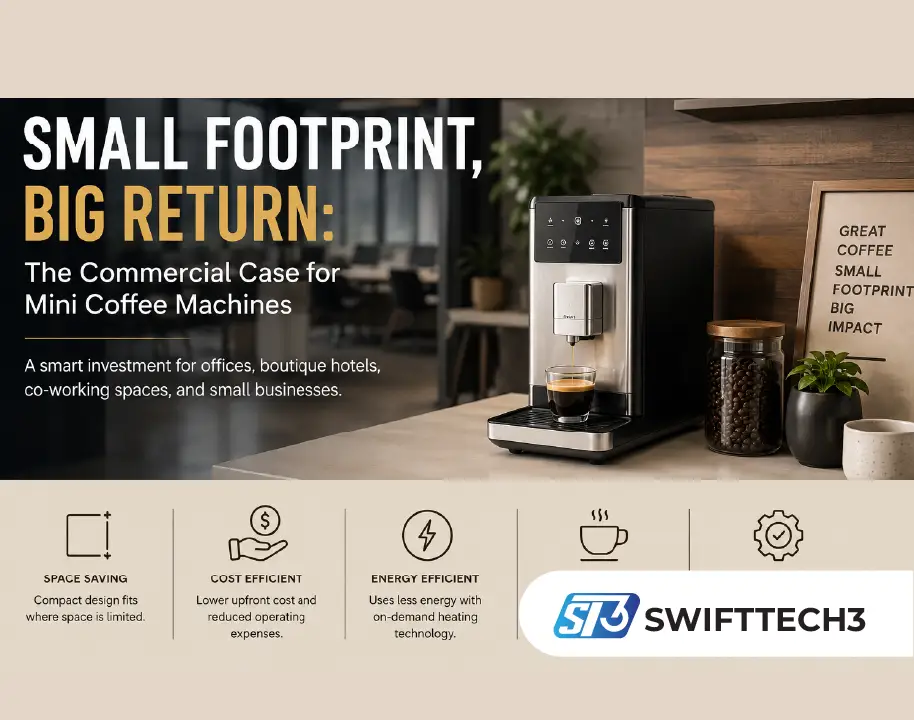
A procurement guide for offices, boutique hotels, co-working spaces, and small retail environments, balancing spatial efficiency, output quality, and total cost of ownership.
Space Is a Commercial Asset
In offices, co-working environments, boutique hotels, and small retail premises, every square metre of counter or floor area carries a measurable financial cost. Procurement decisions for equipment operating in these environments must account for physical footprint alongside functional performance and running costs.
For businesses requiring reliable, quality coffee output within constrained physical setups, a mini coffee machine offers a commercially sound solution that balances output capability with the spatial and budgetary realities of the operating environment. The right compact unit delivers genuine commercial value without the capital outlay, energy consumption, or maintenance complexity that full-size commercial equipment demands.
A compact unit that delivers consistent beverage quality within a fraction of the footprint of a full-size machine allows businesses to deploy coffee service in locations that would otherwise be impractical.
Why Space-Saving Commercial Coffee Machines Benefit Small Offices
In commercial property, operational space has a direct financial cost. A machine that occupies less counter area frees that space for revenue-generating activity or reduces the facility requirement for a dedicated service station.
For co-working spaces, small corporate offices, and boutique hospitality operations where space optimisation is a constant operational priority, this efficiency carries a quantifiable financial value that belongs in equipment procurement calculations alongside output specifications and running costs.
Compact coffee equipment has evolved significantly in recent years. Modern mini coffee machines deliver output quality and menu capability that closely match their full-size counterparts, without the physical and energy footprint that larger commercial units require.
Environments Where Compact Units Excel
- Corporate offices (50–100 employees)
- Boutique hotels
- Co-working spaces
- Small retail premises
- Healthcare waiting rooms
Businesses evaluating small coffee machines for compact commercial environments can access a range of equipment designed to deliver reliable performance within constrained spatial and volume parameters.
Matching Output Capability to Business Volume
Mini coffee machines perform best when matched to operations with low to mid-volume daily requirements. For a corporate office serving fifty to one hundred employees, a boutique hotel offering in-room or lobby coffee, or a small retail space providing complimentary beverages, compact equipment performs at exactly the level service demand requires.
Specifying oversized equipment for these environments inflates acquisition cost, energy consumption, and maintenance complexity without producing a corresponding improvement in service quality or operational output.
Compact vs Full-Size Commercial Coffee Machines
Compact coffee machines offer smaller footprints, lower acquisition costs, lower energy consumption, and simpler maintenance requirements. They are ideal for offices, boutique hotels, and co-working spaces.
Full-size commercial machines provide higher hourly output and are better suited for cafés, restaurants, and large venues with heavy demand. However, they require greater investment, more space, and more complex installation and maintenance.
Cost Efficiency in Lower-Volume Service Settings
The economics of compact coffee equipment are particularly compelling when assessed against the actual service profile of the operation. A smaller machine draws less power, requires less water, and operates at a lower consumables cost than full-size commercial alternatives.
For businesses where coffee is a support service rather than a primary revenue line, these running cost advantages strengthen operating margins across the equipment lifecycle.
The operational cost difference between right-sized and oversized equipment becomes apparent across the full five-year asset lifecycle, where unnecessary energy consumption and avoidable maintenance add materially to total cost.
Pairing compact coffee equipment with a managed coffee vending solution for office environments can further reduce the staff oversight required to maintain consistent beverage service, allowing businesses to provide quality coffee as a staff benefit without allocating personnel to equipment management throughout the working day.
User Experience: What Staff and Visitors Actually Notice
Procurement decisions are rightly driven by financial logic, but the human experience of using office coffee equipment has a measurable impact on staff satisfaction, client perception, and daily workflow.
In co-working and boutique hotel environments, the quality of the coffee offering shapes the first and lasting impressions guests form. Modern compact machines with intuitive interfaces, fast heat-up times, and consistent output create a smooth user experience without demanding dedicated staff or complex operation.
Fast Heat-Up Time
Most compact machines are ready in under 45 seconds, reducing wait times during busy periods.
Intuitive Controls
Modern units feature one-touch operation and simple cleaning cycles, requiring little or no training.
Low Noise Output
Compact machines generally operate more quietly than large commercial units, making them suitable for office environments.
Consistent Quality
Automated extraction removes operator variability, ensuring every cup meets the same standard.
Procurement Principles for Compact Coffee Equipment
The same procurement rigour that applies to full-size commercial equipment applies equally to compact units. Brew quality, maintenance requirements, energy consumption, and supplier service terms should all be included in the evaluation process.
Key Evaluation Criteria
- Daily cup output capacity
- Energy consumption
- Maintenance and service contracts
- Water filtration and descaling requirements
- Supplier warranty and replacement policy
- Beverage menu capability
Frequently Asked Questions
What is a mini coffee machine best suited for in a commercial setting?
Mini coffee machines perform best in low to mid-volume environments such as corporate offices, boutique hotels, co-working spaces, and small retail premises.
Do compact coffee machines match full-size commercial quality?
Yes. Modern compact machines can deliver comparable espresso, latte, and flat white quality. The main difference is capacity, not beverage quality.
How much energy does a compact coffee machine save compared to a full-size unit?
Compact machines typically consume less energy because they use smaller or on-demand heating systems rather than maintaining large boilers continuously.
What should I look for in a compact coffee machine for a small office?
Consider daily cup output, energy efficiency, maintenance requirements, water filtration needs, and warranty coverage.
Can a managed vending solution work alongside a compact coffee machine?
Yes. Managed vending solutions can handle maintenance and restocking while allowing businesses to provide quality coffee without dedicating staff resources.
Is a mini coffee machine a good fit for a boutique hotel?
Yes. Their small footprint, quiet operation, intuitive controls, and consistent quality make them well suited for boutique hotel environments.
Visit: Swifttech3