Auburn is now one of Alabama’s most connected cities: 95 percent of homes sit within reach of high-speed broadband, and fresh fiber splices appear every month. Yet abundance breeds confusion—cable ads shout “gig” speeds, 5G carriers promise plug-and-play freedom, and Starlink beams in from orbit.
We cut through the noise by scoring every residential provider on real-world speed, price, reliability, coverage, and customer satisfaction. Scan this guide and you’ll know which network truly fits your address, budget, and bandwidth appetite.
Why I Wrote This Guide: My Own Auburn Internet Nightmare
When I first moved to Auburn, I assumed picking an internet provider would take fifteen minutes — a quick Google search, a sign-up form, and done. I was wrong. What followed was three weeks of confusing fine print, contradictory customer service calls, and a Wi-Fi connection that buffered every time my neighbor probably sneezed. Nobody warned me that living two blocks in the wrong direction could mean the difference between blazing fiber and crawling DSL. Nobody told me that the “$30 a month” plan I signed up for would quietly become $67 by month four. And absolutely nobody mentioned that the modem rental fee, the installation charge, and the “network enhancement surcharge” were not included in the advertised price. I learned all of this the hard way, sitting on the floor of my new apartment, hotspotting from my phone just to send work emails.
My first apartment was near Tiger Town, which sounds like a great location — and for football Saturdays, it absolutely is. For internet options, though, it was a mixed bag. WOW! served my street, which turned out to be a genuine stroke of luck, but I did not know that at the time. I signed up for Spectrum instead because their ad appeared first in my search results and the price looked lower. What I did not read carefully was the promotional period expiration date buried in paragraph nine of the terms. Twelve months later, my bill jumped without warning, and when I called to ask why, the representative calmly explained that my introductory rate had simply ended. I negotiated a partial discount after forty minutes on hold, but the experience left a bad taste that took a long time to fade.
After that contract cycle ended, I decided to actually research my options properly before signing anything again. I ran speed tests at different hours of the day. I joined local Auburn Facebook groups and asked real residents which providers they used and whether they regretted it. I checked the FCC broadband map. I called each provider and asked pointed questions about price increases, equipment fees, data limits, and what “unlimited” actually meant in their terms. What I discovered surprised me. Auburn has genuinely good internet options — some of the best available in Alabama — but the information is scattered, the marketing is misleading, and the coverage maps are often outdated. A provider might show your address as eligible on their website but send a technician who shakes his head and says the node is full. Another might not even appear in a basic Google search but offer the fastest fiber on your block at a fair price.
I also learned that your situation matters enormously. A renter in a second-floor apartment with a strict landlord cannot always choose the same plan as a homeowner with a garage and a drill. A remote worker who uploads large video files all day has completely different needs than a retired couple who stream one movie each evening. A student moving into a dorm for one semester does not want a twelve-month contract no matter how attractive the monthly rate looks. A family in a rural property outside the city limits may have exactly one realistic option, and knowing how to negotiate within that constraint is its own skill. These distinctions never appear in provider advertisements, but they should shape every decision you make.
That frustrating, expensive, time-consuming experience is exactly why this guide exists. I wanted to build the resource I wished I had found on my first Auburn Google search — one that explains not just what each provider offers on paper, but what you can actually expect when you plug the router in, pay the first bill, and call support at nine on a Tuesday night because the connection dropped during a work deadline. Every provider reviewed here has been evaluated on the factors that actually affected my daily life and the lives of Auburn residents I spoke with directly: real-world speed during peak hours, honest pricing beyond the promotional window, contract flexibility, customer service responsiveness, and coverage that matches what the map claims. No provider paid for placement. No affiliate deal shaped the rankings. The only agenda here is helping you avoid the three weeks of frustration I went through — and get connected to the right network on your very first try.
Ready to pick your plan? Let’s jump in.
How we scored Auburn’s ISPs
Before you compare plans, you deserve to know our rules. A single speed test never tells the full story, so we built a five-factor scorecard that reflects what Auburn households say matters most.
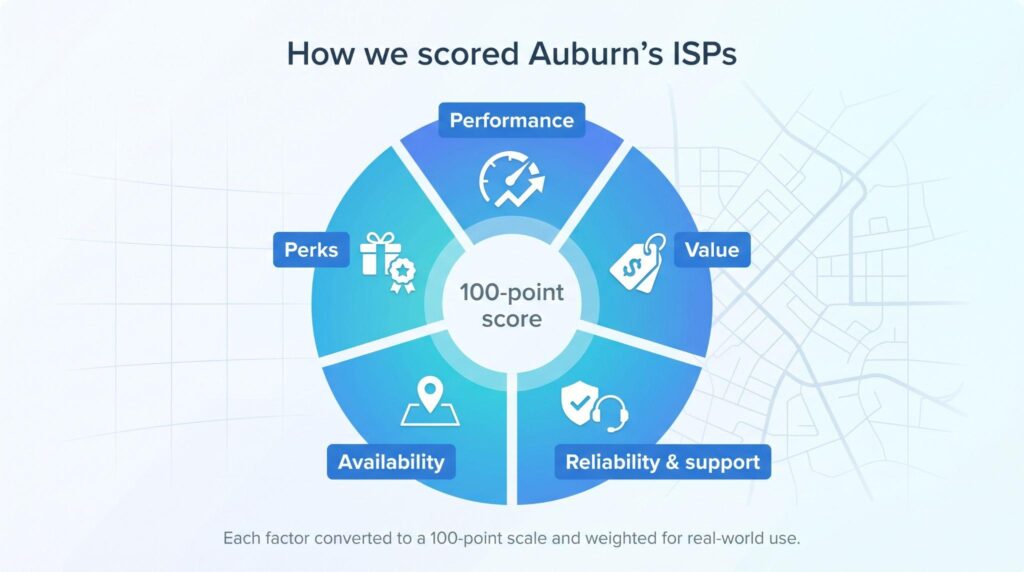
- Performance: Providers earn top marks only if they deliver multi-gig speeds and keep them steady during prime-time Netflix hours.
- Value: Fast internet must still feel affordable; a luxury price knocks points off.
- Reliability and support: National surveys show satisfaction hinges on uptime and quick fixes. Wireless home-internet users, for example, score their providers 647 out of 1,000, versus 554 for cable—data that keeps our ratings honest.
- Availability: A great network limited to two streets can’t outrank a solid one that blankets the city.
- Perks: No-contract terms, price-lock guarantees, and unlimited data give providers an extra nudge.
We convert every data point to a 100-point scale, weight each category, and let the math decide. The outcome rewards consistent, real-world excellence—not flashy marketing claims.
1. WOW! Internet – best value for high speeds
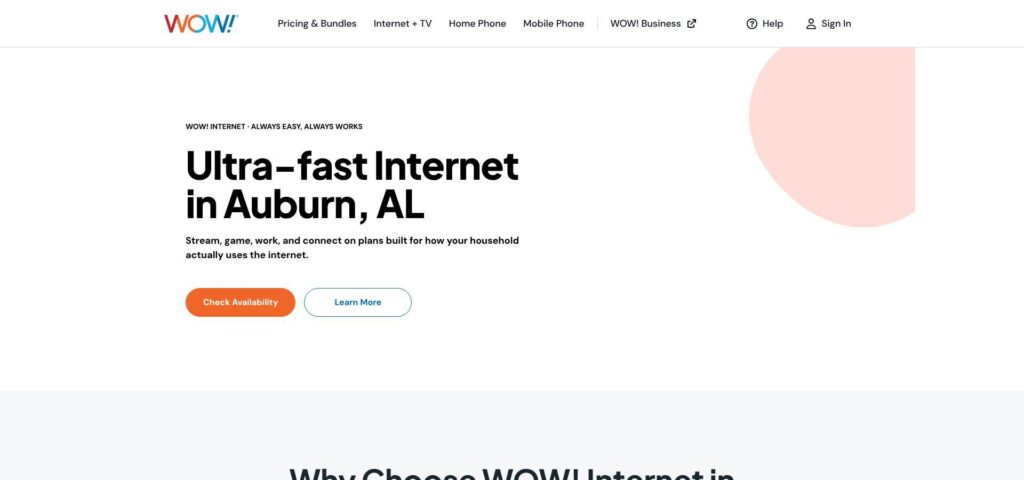
WOW Internet Auburn AL High-Speed Plans and Price Lock Landing Page Screenshot
WOW!’s Auburn, AL high speed internet advertises ultra-fast plans, a free self-install kit, and its Price Lock for Life so your bill never drifts. Beyond those perks, the service still pairs gig-class performance with starter pricing. The 300 Mbps plan starts at $25 per month with autopay, and that price stays put after the welcome email.
Move up to fiber areas and you can order symmetrical 500 Mbps, 1 Gbps, or 3 Gbps service for less than many cable rivals charge for half the speed. Uploads are quick, latency sits in single digits, and every tier includes unlimited data plus a Wi-Fi 6 router.
There are no contracts or data caps. For long-term peace of mind, you can add WOW!’s $5 Price Lock for Life, which the company says will keep your monthly rate fixed for as long as you stay on the same speed tier—no introductory gimmicks or year-two hikes.
New sign-ups also come with a 30-day money-back guarantee if the service falls short.
Coverage reaches about two-thirds of Auburn, including neighborhoods north of downtown and the streets near Tiger Town. If your address qualifies, the value is hard to beat.
2. Spectrum – best city-wide coverage
Spectrum reaches about 90 percent of Auburn addresses, so the odds are high your home already has a live tap. From dorm rooms on College Street to houses in Moore’s Mill, installation is often a quick DIY task: connect the coax line and power up the no-cost modem.
The entry 300 Mbps plan costs around $30 for the first year and scales to a full gigabit. Downloads stay steady during Saturday football, though uploads top out near 35 Mbps. You still get contract-free terms, unlimited data, and Spectrum will cover up to $500 in early-termination fees if you switch.
Rates climb after the promo period, but a quick call to retention often secures a fresh discount. Until fiber reaches every block, Spectrum remains Auburn’s dependable default: fast enough for 4K streaming, available almost everywhere, and easy to leave when something faster arrives.
3. AT&T Fiber – fastest uploads in town
AT&T Fiber is the service power users crave. Its lines deliver 1 Gbps up and down to many Auburn blocks and reach 5 Gbps in the newest zones. Cloud backups, Twitch streams, and large design files leave your computer as quickly as they arrive.
Real-world results match the spec sheet. Latency stays in single-digit milliseconds, and evening slowdowns are rare because the all-fiber path keeps neighbor traffic from touching your bandwidth.
Pricing is simple. Fiber 300 costs $55 per month, Fiber 1000 sits near $80, and both include equipment, unlimited data, and month-to-month terms. Online orders usually waive the install fee, and the gig tier sometimes ships with streaming credits.
Coverage is the lone drawback. About 50 percent of Auburn addresses qualify, mostly in newer subdivisions and areas near campus. Crews continue trenching more lines each quarter, so check your address often.
Choose AT&T Fiber if you upload as much as you download, share bandwidth with gamers or creators, or want the lowest ping in town. When the availability tool shows green, slower options feel hard to justify.
4. Point Broadband – local fiber with a hometown touch
Point Broadband is the neighborhood bakery of internet service: a smaller footprint, but devoted fans praise the taste. The company inherited Opelika’s city-built fiber loops and has expanded them into south and northwest Auburn.
Its flagship plan delivers 1 Gbps up and down for about $65 per month. You get unlimited data, month-to-month billing, and customer support based in Alabama. Outages are rare, and when one happens you will usually see a Facebook update before larger providers open a ticket.
Coverage is limited. Point reaches about 13 percent of Auburn homes, often in pockets other ISPs skipped. If your street qualifies, you gain true fiber where you might expect only DSL or satellite.
Choose Point if you value local service, want fiber speeds, and live inside its growing zones. The sign-up portal is simple, the bill stays flat, and you might see the installer at the grocery store later that week.
5. T-Mobile 5G Home Internet – plug-and-play freedom for renters
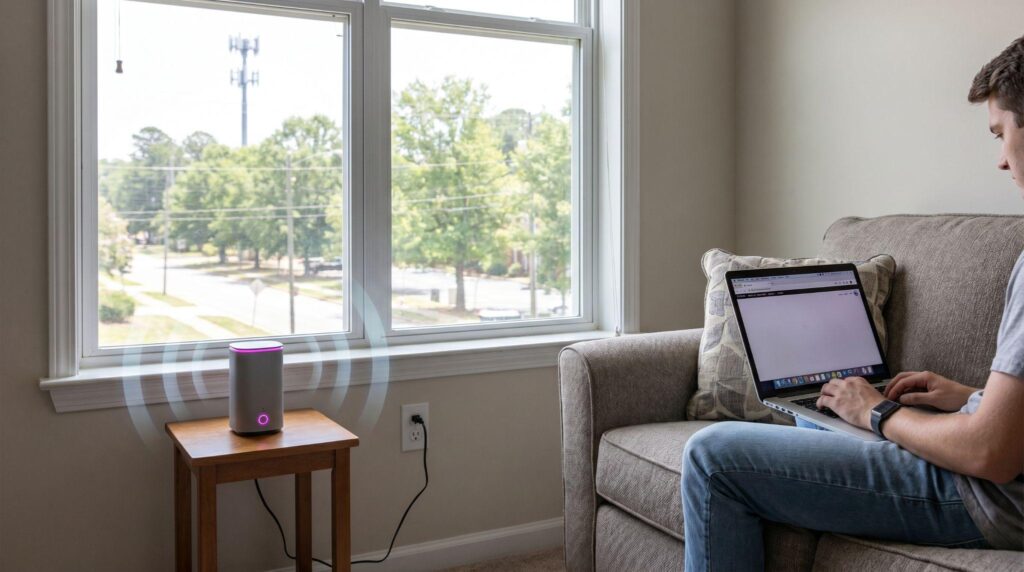
If drilling holes or waiting for a technician sounds painful, T-Mobile offers a simpler route. Unbox the gray gateway, plug it into a wall outlet, and you are online within minutes. The device pulls in T-Mobile’s mid-band 5G signal and shares Wi-Fi across your apartment or small home without cables, landlord approval, or surprise fees.
Most Auburn users report 100 to 200 Mbps downloads and around 15 Mbps uploads—enough for 4K streaming and remote work. A flat $50 monthly bill covers unlimited data, the hardware, and taxes. Magenta Max phone subscribers pay $30 instead.
Coverage reaches about 66 percent of the city. T-Mobile includes a 15-day, risk-free test drive: set the unit on a windowsill, stream a few shows, and keep it only if performance meets your needs. For renters or anyone stuck on slow DSL, this low-commitment trial provides a quick upgrade path.
6. Verizon 5G Home Internet – high-ceiling speeds when the signal is strong
Verizon’s home gateway taps two layers of 5G. Most addresses see a steady 100 to 300 Mbps on C-band, while downtown millimeter-wave nodes can push downloads past 1 Gbps. Uploads land near 20 Mbps, and latency stays around 30 ms, good for casual gaming.
Stand-alone pricing is $50 per month. Customers with an unlimited Verizon phone plan pay $35. The fee covers taxes, the router, and unlimited data, and you can cancel any time.
Setup takes about ten minutes. Place the receiver near a window, watch the app turn green, and connect your devices. Verizon offers a 30-day “love it or leave it” guarantee.
Coverage reaches roughly 50 percent of Auburn and expands after each tower upgrade. Check your address often; eligibility can flip overnight when a new small cell lights up.
7. Starlink – broadband for the last mile and the last cow pasture
Drive ten miles outside Auburn and cable lines fade, cell bars shrink, and AT&T fiber says “coming soon.” This is where Starlink steps in. The pizza-box dish locks onto a swarm of low-orbit satellites and delivers about 100 Mbps wherever a roof sees open sky.

Setup is a weekend DIY task. Mount the dish, run one cable indoors, plug in the router, and the constellation finds you. Latency lands between 25 and 40 ms, quick enough for Zoom classes and online shooters, and data is unlimited.
The trade-offs are cost and line-of-sight. Service starts at $55 per month plus a $349 kit. Trees block signal, so dense canopy lots often need a pole mount. Speeds can dip in busy evening hours as cells fill up.
For rural homes stuck on slow phone lines or pricey LTE caps, Starlink is a lifeline. It enables modern streaming, homework, and telehealth years before fiber arrives. If you can handle the upfront bill and have a clear northern view, this service opens the sky.
Compare them at a glance
Sometimes you only need the numbers. The table below lines up all seven providers so you can spot the best fit in seconds.
| Provider | Network | Auburn coverage | Top speed | Starting price | Contracts | Data caps |
| WOW! | Cable / fiber | ~65% | 5 Gbps | $25 | No | None |
| Spectrum | Cable | ~90% addresses, ~68% land | 1 Gbps | $30 promo | No | None |
| AT&T Fiber | Fiber | ~50% | 5 Gbps | $55 | No | None |
| Point Broadband | Fiber | ~13% | 1 Gbps | $65 | No | None |
| T-Mobile 5G Home | 5G wireless | ~66% | 200 Mbps typical | $50 ($30 with phone plan) | No | None |
| Verizon 5G Home | 5G wireless | ~50% | 300 Mbps typical (1 Gbps peak) | $50 ($35 with phone plan) | No | None |
| Starlink | LEO satellite | 100% clear sky | 220 Mbps | $55 + $349 kit | No | None |
Use the chart as a quick filter. If fiber is on your block, AT&T or WOW! belong on your shortlist. Need service tomorrow with no trenching? Check the 5G options. Live on a rural dirt road? The Starlink row shows what to expect. Keep the table handy while you run each provider’s address check, then choose the plan that matches your speed, budget, and patience.
Stuck with only one choice? Follow this fallback path
Some Auburn addresses still face the single-provider reality. If your lookup shows only one wired option, run this decision path before you sign:
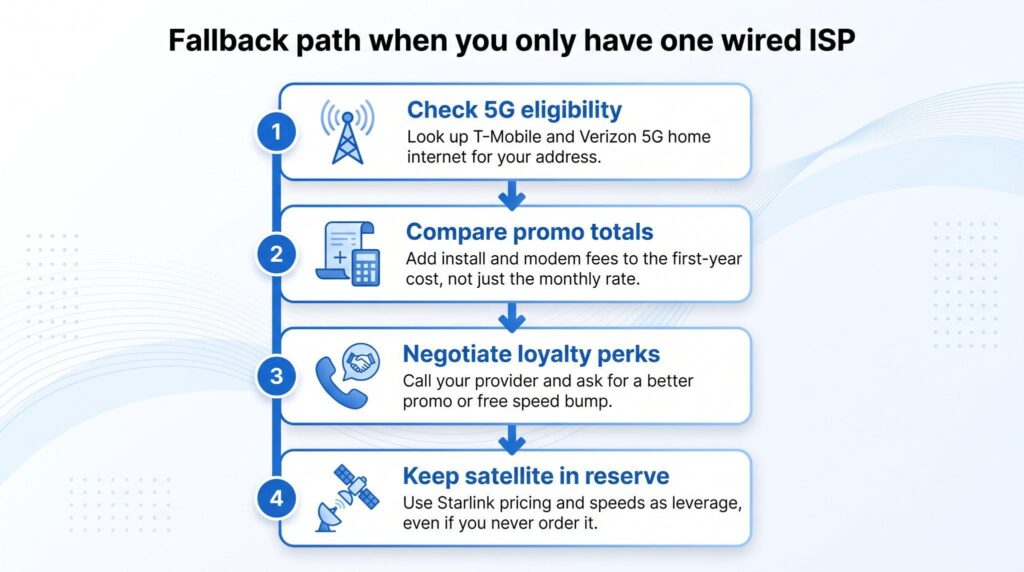
- Check 5G eligibility. Enter your address with T-Mobile and Verizon. Tower upgrades can turn last month’s “unavailable” into a 200 Mbps lifeline.
- Compare promo totals, not just monthly rates. Spectrum’s first-year price looks low, but installation and modem fees can erase the savings. Add those extras before deciding the incumbent is cheaper.
- Negotiate loyalty perks. When a provider knows you have no wired alternatives, ask for a free speed bump or a longer promo. The worst answer is “no.”
- Keep Starlink in reserve. Rural homeowners gain leverage once a clear-sky option exists. Even if you never order the dish, quoting its speed and price during a retention call shows you have done the research.
Work through the list, record real numbers, and choose with confidence. Even if you stay with the only wired ISP in town, you will sign on your terms, not theirs.
Your top Auburn internet questions, answered
Is fiber available everywhere in Auburn?
Not yet. About 50 percent of homes can order a true fiber line, according to the latest FCC coverage data. The city’s overall broadband reach sits near 95 percent, but only half of addresses fall inside a fiber footprint. New streets go live each quarter, so re-check your address before you renew a copper plan.
What’s the cheapest real-broadband plan right now?
WOW!’s 300 Mbps tier leads at $25 per month, and that rate is standard, not a one-year teaser. Spectrum’s 300 Mbps promo starts near $30, but install and modem fees can raise the first bill. If you already carry an unlimited phone plan, T-Mobile Home Internet drops to $30, and Verizon 5G Home falls to $35—worth a look if you have strong signal.
Which option is best for online gaming and livestreaming?
Prioritize low latency and strong uploads. AT&T Fiber delivers single-digit millisecond pings with gig-class upstream, ideal for Twitch and competitive shooters. Spectrum’s cable averages about 20 ms, good for casual play, and WOW!’s fiber zones match AT&T. Wireless and Starlink sit near 30–40 ms; fine for most titles, but less ideal for esports.
Do any of these providers lock you into contracts?
No. All seven offer month-to-month service. Customer-satisfaction surveys show contract-free flexibility is one reason wireless home-internet users rate their providers 647 out of 1,000, versus 554 for cable customers. You can switch as soon as a better deal or faster network reaches your curb.
What’s coming next: faster speeds and wider reach
Auburn’s internet story is still unfolding, and the next chapters look fast.
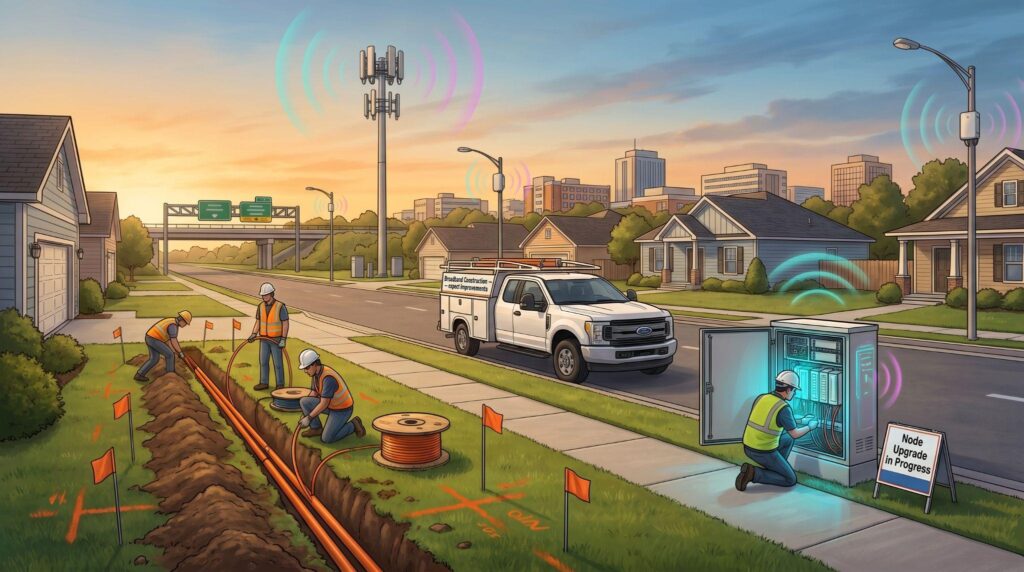
Spectrum engineers have tested DOCSIS 4.0 in nearby markets. When those upgrades hit local nodes, cable uploads could rise from 35 Mbps to several hundred, and multi-gig downloads will become routine. Pilot neighborhoods are expected to light up in December 2026, with city-wide rollout through 2027.
AT&T has filed permits to trench more fiber along the I-85 corridor and several east-side subdivisions. Crews mark lawns, pull conduit, then splice neighborhoods in clusters. If orange flags appear near your mailbox, gigabit service is usually 60 days away.
Wireless capacity is expanding too. T-Mobile continues to add mid-band spectrum to its Auburn towers, a software change that raises average home-internet speeds without new hardware on your end. Verizon is placing more small-cell nodes downtown—the suitcase-size boxes on traffic poles that carry its fastest Ultra Wideband signal.
Affordability is improving. Alabama’s Be Linked initiative is steering state and federal dollars toward last-mile fiber in underserved blocks. Local officials expect the first grant-funded builds to break ground by spring 2027. Homes stuck on slow DSL today could see true broadband without changing address. Bottom line: the menu you just reviewed grows tastier every quarter. Set a reminder to run availability checks twice a year, and be ready to switch the moment a shovel lands on your street.
Visit: Swifttech3