Introduction
On a warm afternoon in Sarasota, Florida, Jake was wrapping up his workday when his phone rang.
As a QA engineer, he spent most of his time helping businesses ensure their websites and applications worked smoothly. The call came from a local service company that relied heavily on online appointment bookings. Customers had suddenly started reporting problems when trying to schedule appointments from their phones.
At first, the issue seemed minor. A booking form was freezing on certain mobile devices. But within hours, the company began receiving frustrated calls from customers who could not complete their requests. Some simply left the website and booked with competitors.
Jake quickly identified the problem and helped the company fix it. By the next morning, the booking system was functioning normally again.
The experience reinforced something he had learned many times throughout his career: customer experience is often shaped by the small digital interactions customers encounter every day. A slow-loading page, a confusing form field, or a checkout button that doesn’t respond can undo weeks of marketing and goodwill in a matter of seconds.
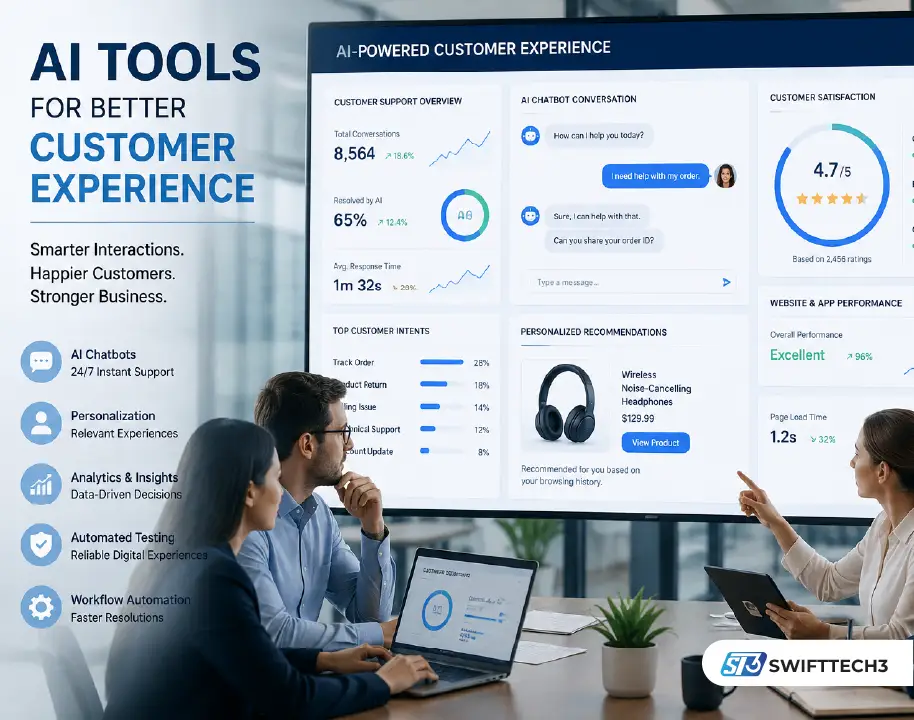
Today, businesses across nearly every industry are turning to artificial intelligence to improve those experiences. From customer support and personalization to software testing and analytics, AI tools are helping organizations better understand and serve their customers.
In this article, we’ll explore some of the top AI tools helping businesses improve customer experience, how they fit together as part of a broader CX strategy, and why they matter in today’s increasingly digital world.
Why AI Matters for Customer Experience
Customer expectations have changed dramatically over the past decade.
Whether someone is ordering a product online, scheduling a home repair, or contacting customer support, they expect fast responses, personalized recommendations, and frictionless experiences.
According to Salesforce’s State of the Connected Customer report, 88% of customers say the experience a company provides is as important as its products or services — among the highest levels Salesforce has recorded since it began tracking the sentiment. That figure has fluctuated somewhat across survey editions, but the underlying trend has held steady for years: experience is no longer a secondary consideration. It’s a competitive differentiator in its own right.
Artificial intelligence helps businesses meet these expectations by automating repetitive tasks, analyzing large amounts of customer data, and identifying patterns that would be difficult for humans to spot manually. Rather than replacing the people behind customer experience, AI typically works best when it removes friction and frees up human teams to focus on the interactions that genuinely need a human touch.
What Is AI in Customer Experience?
AI in customer experience refers to technology that helps businesses improve customer interactions through automation, personalization, analytics, and decision-making support. In practice, this can range from a chatbot answering a support question in seconds, to a testing platform catching a broken checkout flow before a single customer encounters it, to an analytics engine surfacing a recurring complaint buried in thousands of survey responses.
Why Does It Matter?
Businesses that provide better experiences often enjoy:
- Higher customer satisfaction
- Stronger customer loyalty
- Increased revenue
- Lower support costs
- Faster problem resolution
How Does It Work?
AI systems analyze customer behavior, interactions, and feedback to identify opportunities for improvement. They can then automate actions or provide recommendations that enhance the customer journey. Most modern CX platforms combine several of these capabilities — for example, pairing natural language processing (to understand what a customer is asking) with machine learning (to predict what they’re likely to need next) and automation (to act on that prediction without waiting for a human to intervene).
Top AI Tools Helping Businesses Improve Customer Experience
1. testRigor: AI-Powered Test Automation
Many customer experience problems begin long before customers ever notice them.
Broken forms, failed checkout pages, login issues, and mobile compatibility problems can quickly damage trust and lead to lost business.
testRigor is an AI-driven test automation platform designed to help organizations prevent these issues before they reach customers.
Unlike traditional automation tools that require significant coding expertise, testRigor allows teams to create tests using plain English instructions. For example, a tester can write a step like “click ‘Add to Cart’ and verify the cart total updates” instead of writing custom selector-based code. This makes automation more accessible to non-technical staff, including manual QA testers, product managers, and business analysts, and reduces the ongoing maintenance effort that typically accompanies traditional scripted tests. The platform also uses AI-based self-healing, so tests can adapt automatically when minor UI changes occur, rather than breaking every time a button moves or a label changes.
For businesses that depend on digital interactions, reliable software directly affects customer satisfaction.
Many customers prefer scheduling service appointments online rather than making phone calls. If the booking system experiences technical issues, customers may become frustrated and choose another provider, often without ever contacting support to report the problem.
By using no-code automated testing tools like testRigor, businesses can identify and fix problems before they impact real customers. This kind of testing is especially valuable for companies running frequent releases, since it allows teams to catch regressions quickly without slowing down deployment.
Pros
- Easy-to-create automated tests
- Reduced maintenance requirements
- Faster software releases
- Improved digital reliability
- Better user experiences across web and mobile
Cons
- Requires initial setup and planning
- Organizations must define proper testing strategies
- Plain-English test steps can be ambiguous if not written carefully, so some teams still benefit from a QA lead who reviews test coverage
2. Zendesk AI
Customer support teams often face increasing ticket volumes and rising customer expectations.
Zendesk AI helps organizations automate support workflows, categorize requests, recommend responses, and resolve common issues more efficiently. It can triage incoming tickets by urgency and topic, suggest relevant knowledge base articles to agents in real time, and handle straightforward requests — such as order status or password resets — without human involvement.
Instead of waiting hours or days for assistance, customers can often receive answers immediately.
This creates a smoother support experience while reducing operational costs, and it gives human agents more time to focus on complex or sensitive cases that genuinely require judgment and empathy.
Best For
- Customer support teams
- Service organizations
- E-commerce businesses
3. HubSpot AI
Personalization has become one of the most important elements of customer experience.
HubSpot AI helps businesses understand customer behavior and deliver more relevant content, emails, and recommendations. It can analyze a contact’s browsing history, email engagement, and purchase patterns to suggest the next best action, whether that’s a follow-up email, a content recommendation, or a sales handoff.
Customers are more likely to engage with companies that understand their interests and needs.
According to McKinsey, companies that excel at personalization generate 40% more revenue from those activities than average performers, and fast-growing companies derive a meaningfully larger share of their revenue from personalization than slower-growing competitors. The takeaway for most businesses isn’t that personalization alone guarantees growth, but that it’s strongly correlated with stronger customer relationships and retention.
Best For
- Marketing teams
- Lead nurturing
- Customer engagement campaigns
4. Intercom Fin AI
Customers increasingly prefer finding answers on their own rather than waiting for support representatives.
Intercom Fin AI uses advanced AI capabilities to answer customer questions using company documentation and knowledge bases. It’s built on large language model technology, which allows it to understand the intent behind a customer’s question — even if it’s phrased differently than the source documentation — rather than relying solely on keyword matching.
Customers receive immediate assistance while support teams can focus on more complex issues.
This combination improves efficiency without sacrificing customer satisfaction, though businesses should keep their knowledge base accurate and up to date, since an AI assistant is only as reliable as the documentation it draws from.
Best For
- SaaS companies
- Online service providers
- Businesses with large support volumes
5. Qualtrics XM
Customer feedback is valuable, but manually reviewing thousands of comments and survey responses can be difficult.
Qualtrics XM uses AI to analyze customer feedback, identify trends, and uncover hidden insights. Its text and sentiment analysis capabilities can flag recurring themes — for instance, repeated mentions of slow delivery times or confusing pricing — that might otherwise take a team weeks to identify manually.
Businesses can better understand what customers like, dislike, and expect.
This enables continuous improvement based on real customer data rather than assumptions, and it can help prioritize which experience issues deserve attention first based on how frequently and severely they affect customers.
Best For
- Experience management
- Customer feedback analysis
- Brand perception monitoring
6. Salesforce Einstein
Salesforce Einstein adds AI capabilities directly into the Salesforce ecosystem.
It helps businesses predict customer needs, automate sales activities, and provide personalized recommendations. Because it’s built into the CRM that many sales and service teams already use daily, Einstein can surface predictive insights — such as which leads are most likely to convert or which customers show early signs of churn — directly within existing workflows, rather than requiring teams to switch between separate tools.
Organizations gain deeper visibility into customer behavior and can proactively address issues before they become problems.
Best For
- Enterprise organizations
- Sales teams
- Customer relationship management
Comparison Table
| Tool | Primary Function | Best For |
|---|---|---|
| testRigor | AI Test Automation | Software Quality and Reliability |
| Zendesk AI | Support Automation | Customer Service Teams |
| HubSpot AI | Personalized Marketing | Customer Engagement |
| Intercom Fin | AI Customer Support | Self-Service Support |
| Qualtrics XM | Feedback Analysis | Experience Management |
| Salesforce Einstein | Predictive Insights | Customer Relationship Management |
What Industry Experts Are Saying
Microsoft CEO Satya Nadella highlighted the growing impact of artificial intelligence when he described AI as a transformative force shaping the current technological era.
While AI affects many areas of business, customer experience remains one of the most visible and impactful applications. It’s often the first place customers personally encounter the results of a company’s AI investments, whether that’s a faster support response or a website that simply works the way it should.
Organizations can use AI to understand customers more deeply, respond more quickly, and continuously improve their services. Industry analysts including Gartner and Forrester have both pointed to customer experience as one of the leading use cases driving enterprise AI adoption, alongside areas like software development and internal operations.
Real-World Example: AI and Local Service Businesses
Imagine a homeowner whose refrigerator suddenly stops working on a Friday evening.
After searching online in the Sarasota area, they find D.R. Express Service Appliance Repair and attempt to schedule an appointment.
The customer experience may seem simple on the surface:
- The website loads quickly.
- The booking form works correctly.
- Support questions are answered immediately.
- Appointment confirmations arrive promptly.
Behind the scenes, several AI-powered technologies may be helping create that experience:
- Automated testing ensures booking systems work properly.
- AI chat tools answer customer questions.
- Analytics platforms identify website issues.
- Personalization tools improve communication.
The homeowner may never know which technologies are involved. They simply experience a company that is easy to work with — and for a local service business, that ease often determines whether a one-time customer becomes a repeat one.
That is the true value of AI in customer experience: it works best when it’s invisible, removing friction rather than drawing attention to itself.
Key Insights
- Customer experience extends beyond customer service.
- Every digital interaction affects customer perception.
- AI can improve both efficiency and satisfaction.
- Reliable software is essential for customer trust.
- Personalization drives stronger customer relationships.
- Data-driven decisions help businesses improve continuously.
- The most effective AI tools tend to be the ones customers never notice using.
Practical Steps for Businesses
If you’re considering AI tools to improve customer experience, start with these steps:
- Identify your biggest customer pain points.
- Gather customer feedback regularly.
- Prioritize tools that solve specific problems.
- Start small and measure results.
- Monitor customer satisfaction metrics.
- Continuously optimize based on data.
A practical tip many CX and QA teams follow: before investing in new customer-facing AI tools like chatbots or personalization engines, it’s worth confirming that the underlying digital experience — the website, app, or booking system — is reliable. Personalized marketing and instant support won’t matter much to a customer who can’t complete a purchase or booking in the first place.
Potential Limitations of AI
While AI offers significant benefits, businesses should understand its limitations.
- Initial implementation costs
- Employee training requirements
- Dependence on quality data
- Need for ongoing monitoring
- Human oversight remains necessary
- AI tools can produce inaccurate or overly generic responses if not properly configured or regularly updated
- Over-reliance on automation can frustrate customers who need nuanced or empathetic help that only a human can provide
The most successful organizations view AI as a tool that supports people rather than replacing them entirely. The businesses getting the most value from AI in customer experience tend to treat it as an ongoing practice — regularly reviewing what’s working, retraining models or updating knowledge bases as needed, and keeping a clear path for customers to reach a human when automation isn’t enough.
Frequently Asked Questions
What is the best AI tool for improving customer experience?
There isn’t a single “best” tool, since the right choice depends on the specific problem a business is trying to solve. Companies focused on support volume often start with Zendesk AI or Intercom Fin, those prioritizing personalized marketing tend to use HubSpot AI or Salesforce Einstein, and businesses concerned about technical reliability often start with AI-powered testing platforms like testRigor.
How does AI improve customer experience?
AI improves customer experience by automating repetitive tasks, personalizing communication, analyzing feedback at scale, predicting customer needs, and identifying technical issues before they affect customers. The combined effect is typically faster response times, more relevant interactions, and fewer broken or frustrating digital experiences.
Is AI replacing customer service jobs?
AI is automating routine and repetitive tasks, such as answering common questions or categorizing tickets, but it generally works best alongside human teams rather than replacing them outright. Most organizations use AI to handle simple, high-volume requests so human agents can focus on complex or emotionally sensitive interactions that benefit from empathy and judgment.
What industries benefit most from AI in customer experience?
E-commerce, SaaS, financial services, healthcare, and local service businesses (such as home repair and appliance services) all benefit significantly, since each relies heavily on digital interactions, online bookings, or high support volumes where AI can reduce friction.
Can small businesses afford AI customer experience tools?
Many AI-powered platforms, including testRigor, Zendesk, HubSpot, and Intercom, offer tiered pricing plans designed for smaller businesses, making AI more accessible than it once was. That said, costs and feature sets vary by vendor and plan, so it’s worth comparing options against a business’s specific budget and needs before committing.
What is the difference between AI testing tools and AI customer support tools?
AI testing tools, such as testRigor, focus on preventing technical problems by automatically testing websites and applications before customers encounter issues. AI customer support tools, such as Zendesk AI or Intercom Fin, focus on directly assisting customers with questions and problems after they’ve reached out. Both contribute to customer experience, but they address it from different ends of the journey — one prevents friction, the other resolves it.
Do AI tools work well together, or should businesses pick just one?
Most businesses get the best results by combining tools that address different parts of the customer journey rather than relying on a single platform for everything. For example, a company might use testRigor to ensure its website functions properly, Zendesk AI or Intercom Fin to handle support inquiries, and HubSpot AI or Salesforce Einstein to personalize marketing and sales outreach.
How do I measure whether an AI customer experience tool is actually working?
Track metrics tied to the specific problem the tool addresses: response times and ticket resolution rates for support tools, conversion and engagement rates for personalization tools, and defect or downtime rates for testing tools. Customer satisfaction scores (CSAT), Net Promoter Score (NPS), and customer effort score (CES) are useful broader indicators that can show whether AI investments are translating into a better overall experience.
Are there risks to using AI in customer experience?
Yes. Risks include inaccurate or generic AI-generated responses, over-automation that frustrates customers seeking human help, data privacy concerns, and the cost and effort of proper implementation and ongoing monitoring. Businesses that succeed with AI typically treat it as a supplement to human service rather than a full replacement.
Conclusion
Back in Sarasota, Jake finished helping the service company restore its booking system and watched customer appointments begin flowing in again.
The problem had been small, but its impact on customer experience was significant.
That lesson applies to businesses everywhere.
Customer experience is often built through countless small interactions. A functioning website, a personalized email, a fast support response, or a seamless booking process can determine whether a customer returns or looks elsewhere.
AI tools like testRigor, Zendesk AI, HubSpot AI, Intercom Fin, Qualtrics XM, and Salesforce Einstein are helping businesses create those positive experiences more consistently than ever before — not by replacing the people behind a business, but by removing the friction that gets in their way. For businesses just getting started, the practical path forward is usually the same: identify the specific pain point causing the most customer frustration, choose a tool built to solve that problem, and measure the results before expanding further.
As technology continues to evolve, one question remains worth considering:
How many customer relationships could be strengthened simply by making every interaction a little easier?
Visit: Swifttech3.com